V.  WHO’S WHO?  WHERE’S WHERE?

It was at Rome, during the Carnival that I attended a masquerade in the palazzo of the Neapolitan Duke Di Broglio. . . And again, and again, in secret communion with my own spirit, would I demand the questions ‘Who is he?--whence came he?--and what are his objects?’  But no answer was there found.

“William Wilson”
Edgar Allan Poe

     Related to the motif of one character transforming into another is the repetitive appearance in L'eclisse of strangers, a kind of metaphysical peek-a-boo.  Who, for example, is Franco?  Early in the film, Vittoria telephones “Franco,” asking him to watch over Riccardo.  Later, Piero in his office refers to “Franco” who, again, remains ultimately unidentified.  The film offers no evidence to suggest--or reason to believe--that Franco #1 and Franco #2 are the same person, or are they?  (In the screenplay contained in Lane’s book on L'eclisse--a screenplay which differs significantly from the final film--“Franco” is the name of Marta’s husband.)  An analogous mystery in The Passenger concerns the identity of “Daisy,” a person with whom David Robertson has several appointments, but whose identity is never revealed.  Identity is so elusive in The Passenger that a central protagonist, the Girl, is not even given a name.  This is also the state of affairs for the characters played by David Hemmings and Vanessa Redgrave in Blow-Up, or “Mark and Daria” of Zabriskie Point.*

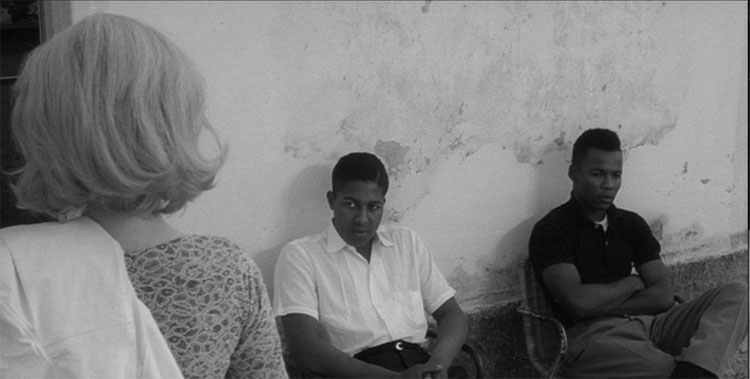
     People suddenly pop up out of nowhere, appear, disappear, are never identified, play no obvious role in narrative continuity.  (One is reminded of the cryptic, recurrent appearance of the Man in the Mackintosh in Joyce’s Ulysses.  The penultimate episode of Ulysses also has a celestial resonance with L'eclisse.  Has not Antonioni also spoken to us of the lethargy of nescient matter:  the apathy of the stars?)  Examples that have already been mentioned include both the Drunkard and the woman in the window across from the apartment of Piero’s parents (also functioning as a mirror image).  Some of these transients reappear in the coda of the film, such as the jockey or the nursemaid. The camera may linger upon them in a lazy manner, inviting us to question their identity, their importance, their existence.  At the Verona airport--a hole in time, a true suspension of cinematic momentum, temps mort as described by Chatman--we watch Vittoria watching others . . . and as Antonioni shows us the objects of her regard, we are invited to gaze upon them as well.  Two seemingly incongruous black men sitting on a bench, a man lounging at a bar with a beer eying Vittoria, two men conversing at an outside table, suddenly become the center of the camera’s attention.  If one strains one’s ear and eavesdrops on the faint conversation of these two Americans, one hears one of the men saying to the other, “We’re the center of attraction . . .” a typically small but meaningful, little joke on Antonioni’s part.  Centrifugal force in Antonioni’s films is such that the center of attention seems to be routinely drawn out of orbit to be propelled like Anna of L’avventura to God knows where.  The very ending of L'eclisse with its image of a luminous orb may be seen as an embrace of Copernicus, men and women cast outward to the third planet from the Sun.  Rifkin (p. 148) goes so far as to say that in The Passenger, Locke is not the true subject of the film.  May one likewise say that the main characters of L'eclisse are not Vittoria and Piero, but a broken stick and matchbook, the Remains of a Day?
Marta's apartment
Marta's apartment

     The black men are of particular interest.  Antonioni’s camera gazes lazily upon these two men, the back of Vittoria’s head in the foreground.  Their incongruity or digressive nature is lessened when we remember that the scene at the Verona airport follows on the heels of the African adventure at Marta’s apartment.  Africa has “bled” outside the confines of Marta’s apartment into Northern Italy, just as Marta’s Kenyan farm has failed to be contained within the photograph on the wall of her apartment, but is instead located under Vittoria’s finger on the white wall to screen-left of the photo (vide ante).  In this context the two black men plastered against a white wall provoke a complex reverberation of thematic concerns.  Once again, we confront the Antonionian preoccupations with repetition and mirror images.*  We must remember that there were photographs of native African tribes plastered on the walls of Marta’s apartment.  When Vittoria puts on blackface and African garb in Marta’s apartment, Anita holds up such a photograph of a real African woman next to Vittoria’s head, asking Marta if there is a resemblance.  It is Vittoria who replies, “Identica!”  Thus, there is an equivalence between Vittoria disguised as African woman and the photograph of an African woman.  Reification.  Metamorphosis. Adumbration also operates insofar as the scene in Marta’s apartment foreshadows the later appearance of the “African scene” at the Verona airport.  Likewise, as Vittoria pauses in front of the two black men, presenting only the back of her mind to us, we can imagine that she is thinking back to the previous scene in Marta’s apartment. The two men also resemble objects--that is to say, photographs--in the manner in which they are placed against the white, outside wall of the airport lounge, which, thus, resembles a gallery. In one sense, we have never really left Marta’s apartment, for the airport wall with its portrait of black men is also the apartment wall with its portrait of black men. A further, provocative way of viewing this scene is to think of a black and white photographic negative: Vittoria in the Africa of Marta’s apartment is the negative of Africans in Verona.*

     The African motif and image of an African woman will reappear one last time towards the very conclusion of L'eclisse.  In the final moments shared by Vittoria and Piero in the broker’s office, a buzzer rings. Vittoria and Piero dress, Vittoria placing a chain around her neck, Piero performing the analogous act of putting a tie, or if you will, a noose around his neck.  As they head towards the front door of the office where they will share their final embrace--an embrace without a kiss or the utterance of a goodbye--they pass a small statuette of an apparent African woman, one that resembles the photographs of African women with headdress adorning the walls of Marta’s apartment.  This small token of a woman, one perhaps made of wood, reunites simultaneously several themes that have operated throughout the film:  an African woman is reified into an inanimate object; the image of an African woman is doubled, reoccurs, incessantly reappears; human beings are shrunken, to the size of a small statuette or to the dimension of a miniature woman trapped inside a pen.

     Already alluded to is the photograph of Vittoria’s father dressed in the Italian military uniform of the Ethiopian campaign.  This, too, constitutes a costume, albeit in sharp contrast to that of Vittoria.  Whereas Vittoria is attempting to identify with Africa, to be an African, her father’s travesty at best concerns the adaptation of a role as a conqueror of Africa, at worst that of a thief or rapist camouflaged as a soldier in a shameful chapter of modern Italian history.  Vittoria’s father was not, however, the first Italian to invade Africa.  In the First Punic War Rome invaded Carthage in 256/255 B.C.E. and suffered a disastrous defeat at the Battle of Tunis.  Much of the surviving Roman fleet was subsequently destroyed by a violent storm on their return home.  Some 2,000 years later the Italian Army fared little better in the First Italo-Ethiopian War with a catastrophic defeat at Adua (“The casualty rate suffered by Italian forces at the Battle of Adowa [Adua] was greater than any other major European battle of the 19th century, beyond even the Napoleonic Era’s infamous Waterloo and Eylau.”  [http://en.wikipedia.org/wiki/First_Italo%E2%80%93Ethiopian_War   retrieved 5 May 2009]).  Mussolini would later in the 20th century forget the famous observation by Santayana that “Those who cannot remember the past are condemned to repeat it,” and start the Second Italo-Ethiopian War.  (Antonioni, himself, traveled as a journalist to the Italian colonies of Africa in 1939; see Cardullo and his chronology of Antonioni’s life in Michelangelo Antonioni: Interviews; available as of 3 April 2009 at:  <http://books.google.com/books?id=5PIfqF7BP9wC&printsec=frontcover#PPR23,M1>).  When one considers how carefully Antonioni had already defined the differences between mother and daughter--and, now, between father and daughter--one might say that Vittoria is not her parent’s daughter (as opposed to Piero, who still seems to be living part time at his parent’s home and who prefers the funereal abode of his parent’s apartment as the place to seduce Vittoria rather than his own apartment).  Like Mavi in Identificazione di una donna, Vittoria’s namesake (“Mavi,” an abbreviation for “Maria Vittoria”), Vittoria might have questions regarding her own paternity.

     Vittoria’s masquerade as an African woman occurs abruptly, unexpectedly, appearing as if out of nowhere.  There is the sense that the African scene is so discrepant and parenthetical that it represents “a play within the play,” a kind of meta-theatre resembling in some curious manner a Japanese Noh or Kabuki drama à la Africana-Italiana (such Japanese drama commonly concerned with the themes of the double suicide of lovers, the inexorable passage of time, ephemera, and loss).  There is an odd, self-reflexive quality to Vittoria’s “performance,” making us wonder why an otherwise generally demure translator would suddenly engage in such a dramatic, histrionic, and “out-of-place” performance.  Indeed, the bedroom of Marta’s apartment that is flanked by two black, thatched “stage wings” resembles a proscenium upon which Vittoria puts on her vaudevillian act.  Nothing thus far in L'eclisse has prepared us for the exuberance and playfulness of this scene, one that is 180 degrees opposed to the deathlike stillness of the opening scene of the filmAlthough the scene has comic elements, it is not sexualized as is the dance of the “real” black woman in the nightclub episode of La notte.  (Although Piero regards Vittoria as a sex object, Antonioni is careful to not present Vittoria as a highly charged, erotic character.)  The scene of Vittoria adopting the skin of an African woman is so peculiar and hysterical that Marta--visibly uncomfortable with the charade--demands that it stop.  (Pincus notes that the two black men “with their calm presence . . . contrast with the tribal hysterics of Vittoria the night before”).  One of the more important Antonionian motifs of this scene is that of evasion, flight, escape.  As Chatman has written in his book on Antonioni (p. 60):  “The theme of escape appears in some form in virtually every one of Antonioni’s films, even his first.  In Gente del Po (“People of the Po [River]”), a woman working in the fields watches a barge pass down the river, and the voice-over reads her mind:  ‘She thinks perhaps of happiness.  To leave, to travel, to change her life.  The sea is there, at the end of the trip.’ ”  In 1942, however, the year prior to shooting Gente del Po, Antonioni worked as a co-screenwriter on Rossellini’s Un pilota ritorna (“A Pilot Returns”), a film literally concerned with “escape.”  (“[The film received the] first-place award in 1942 at the international film competition sponsored by the GIL [Gioventù Italiana del Littorio], the youth organization of the Fascist Party.” [Re-viewing Fascism.  Reich, Jacqueline and Garofalo, Piero.  Editors.  P. 89].)  This was Antonioni’s first significant involvement with a major studio film, as opposed to his early 1943 involvement with Gente del Po which was a short documentary.  Nevertheless, Un pilota ritorna—a fascist propaganda film conceived by Mussolini’s own son, Vittorio (a man whose refinement was such that he described bombs as “budding roses” and killing as “exceptionally good fun”), while Antonioni was himself still a non-commissioned officer in the Italian Army—tells the story of an Italian bomber pilot played by Massimo Girotti (later to star in 1950 in Antonioni’s debut as director of a feature film, Cronaca di un amore) who is shot down behind enemy lines on a bombing run over Greece and captured by English and Greek soldiers.  (See Biarrese and Tassone for a brief biographical account of Antonioni’s war years and his service as a “telegrafista” in the signal corps of the Italian army.)

[Author’s addendum, 5 March 2010:  Antonioni, despite his many interviews and writings, was a famously private man and no comprehensive biography of him has ever been published.  The specific issue of Antonioni and fascism—an issue that has received relatively scant if any substantive attention in the past—has attracted recent attention due to (1) a documentary by director Felix Moeller, Harlan - Im Schatten von Jud Süss (“Harlan - In the Shadow of Jud Süss”), 2008, and (2) an unrelated, large-scale production film that is a fictional retelling of the making of the film, Jud Süß, by director Oskar Roehler, Jud Süss: Film ohne Gewissen (“Jud Süss: Film Without Conscience”), 2010.  Both of these very recent German films concern the infamous 1940 Nazi propoganda film by director Veit Harlan, Jud Süß, “The most effective of all Nazi anti-Jewish productions.” (Friedländer, Saul.  Nazi Germany and the Jews, 1933-1945.  p. 188.)  Antonioni, 28 years old at the time and a film critic, viewed the 5 September 1940 world premiere of this film at the Venice Film Festival and wrote a favorable review in Corriere Padano, 6 September 1940 (La settimana cinematografica di Venezia.  “L’ebreo Suess” e “Il cavaliere di Krua”).  Subsequently, Antonioni worked for a brief period in 1940 as a critic for the principal fascist film journal, Cinema, whose editor was Vittorio Mussolini. 

     Antonioni was employed as a journalist approximately between the years of 1935-1940 which required a special certificate of approval issued by the fascist party; such certificates were secretly granted without public record in order to promote the illusion of a free press.  Benito Mussolini had himself been a journalist in his youth and understood well the necessity for absolute control of the Fourth Estate. (see:   http://en.wikipedia.org/wiki/Benito_Mussolini    retrieved 12 March 2010).  Ferrara, where Antonioni was born in 1912 and where he lived until 1931 when he left for university in nearby Bologna, is widely regarded in Italy to this day as a cradle of Italian fascism (Bologna, like Ferrara, also losing its traditional liberal roots to become a stronghold of fascist activity during the rise of “il Duce”).  Paul Corner writes that “It was Ferrara that formed the spearhead of the extremely rapid expansion of agrarian Fascism which—at the beginning of 1921—effectively rescued the town-based Fascism of Mussolini from extinction.” (Corner, Paul.  Fascism in Ferrara, 1915-1925, p. X.)  Both Alberto Lattuada’s Il mulino del Po (1949) and Bernardo Bertolucci’s Novecento (1976; USA title, “1900”) portray this provincial conflict between socialist and fascist adversaries in Emilia-Romagna, this overt political element characteristically missing in Antonioni’s extant documentary on the region, Gente del Po (shot in 1943).

     Jud Süß had been banned as early as 1941 in Sweden and sale of the DVD is presently prohibited in Italy.  Standing opposed to Antonioni’s appreciation of Jud Süß is that of Harlan’s daughter, Maria Körber, who has described her reaction to her father’s film:  “I wept and was in despair, I couldn’t believe what I saw.  It was horrific.  I felt like going outside and puking.”  Veit Harlan’s son, Thomas Harlan, went so far as to accuse his father of having “created an instrument of murder.” (“The film was seen by an estimated 100 million people across Europe and was made required viewing for the SS by Heinrich Himmler.”  This latter statement and the quotations of Harlan’s children are cited in “The Los Angeles Times,” page D6, 11 June 2010.)  On August 18, 1940, after screening the final cut of the Jud Süß, Goebbels wrote in his diary:  “An anti-Semitic film of the kind we could only wish for.  I am happy about it.”  (Die Tagebücher von Joseph Goebbels Teil I: Aufzeichnungen 1923-1941; cited on Internet site:  http://www.holocaustresearchproject.org/holoprelude/judsuss.html.  Retrieved 4 August 2010.)  What is most striking about Antonioni’s 6 September 1940 review is what it does not say.  Antonioni had looked at the face of evil upon the silver screen and then wrote a review that was relatively innocuous in its tone—emphasizing Antonioni’s opinion of the praiseworthy technical aspects of Jud Süß as opposed to an examination of what really makes the film extraordinary, its content.  Compared to the agonizing hysteria of Jud Süß, Antonioni’s analysis is ultimately as dry as bone and ash.  There is not so much as a nod to what the film is fundamentally about, a rascist portrayal of Jews made under the direction of the Third Reich. (Jud Süß was not The Merchant of Venice anymore than Hitler was Elizabeth I.)  It is as if Antonioni had somehow missed—not seen—the entire point of Jud Süß:  its incessant, elaborate, heavy-handed incitement to anti-Semitism, something which was not lost upon Goebbels, the true “director” of the film.  The peculiar result of Antonioni’s “analysis” is that we are left with a review praising a horrific anti-Semitic film in which the reviewer himself otherwise betrays no overt anti-Semitism.  It is reasonable to assume that Antonioni “saw” full well the import of Jud Süß.  If he didn’t, then something was very wrong somewhere.

     It is important to remember the precise historical context in which Antonioni was writing of a film such as Jud Süß (See “Historical Background Sketch.” Italian Cinema in the Shadow of Auschwitz. pp. 3-9. Marcus, Millicent.)  Since the Risorgimento and unification of Italy in the latter part of the 19th century, Jews had been granted rights as Italian citizens and to a great degree were assimilated into and accepted by Italian society.  It was not until 1938-1939 when Mussolini initiated the “Racial Laws.” As Marcus reminds us (p. 7), Italian Jews, a miniscule percentage of the Italian population, were suddenly subject to “.  .  . the most comprehensive set of anti-Semitic rules, setting limitations on property and business ownership by Jews, barring them from mixed marriages, military service, and the employment of Christian domestic help and denying them positions in banks, insurance companies, or government offices .  .  . owning radios, listing their names in telephone directories, placing obituaries in local newspapers, giving public lectures, or attending vacation resorts.”  Was Antonioni—highly sophisticated, intellectually curious and naturally inquisitive, well read in multiple languages, a university graduate who counted among his friends and with whom he played tennis, Giorgio Bassani and other Ferraresi Jews, members of the oldest Jewish community in all of Europe—not aware of such “laws,” anti-Semitic rants inscribed on government billboards plastered like movie posters on Italian streets throughout Italy?  Had Antonioni any familiarity with the onerous Nürnberg Laws that had been promulgated in Germany in 1935?  Did Antononi not know of the ominous and potentially catastrophic alliance signed between Italy and Germany on 22 May 1939, the Pact of Steel (German: “Stahlpakt”; Italian: “Patto d'Acciaio”)?  In September of 1940 was Antonioni not aware that Hitler’s armies had conquered much of Europe?  Did Antonioni not have any notion regarding Hitler’s attitude toward Jews as had been clearly laid out for all to see in Mein Kampf as early as 1925-1926?  Was Antonioni—a man whose life, even then, was consecrated to the cinema—unaware that the monolithic German studio, Ufa, now the mouthpiece of the Third Reich, was not only producing anti-Semitic feature films such as Jud Süß but also virulently anti-Semitic newsreels whose goal was not art, enlightenment, or entertainment but de-humanization?  A 1941 Ufa newsreel drones: “This eastern Jewish sub-humanity has brought criminal riff-raff to western Europe since the beginning of time.  This scum has supplied democracies with pickpockets, pimps, drug dealers, white slave traders, international bank grafters, and seditious reporters.  These are the same Jews whose brothers, sons, and cousins are spokesmen for humanity and civilization in London and Paris.” (Rome is omitted.)  [This portion of the Ufa newsreel may be viewed in the excellent 2006 German documentary film by director, Michael Verhoeven, Der unbekannte Soldat (“The Unknown Soldier.  What did you do in the war, Dad?”)]  In fairness to Ufa, directors such as Harlan, and critics such as Antonioni .  .  . art, enlightenment, and entertainment were now no longer distinguishable from de-humanization.

     By the onset of World War II, the Venice Biennale Film Festival—to be rechristened in 1940 the “Manifestazione Cinematografica Italo-Germanica” (“Italian-German Film Festival”)—had forged an unholy alliance with Mussolini’s Ministry of Popular Culture which “encouraged its full appropriation by the regime’s propaganda machine .  .  . After 1937, the prize for the best foreign film went without exception to Nazi Germany.” (See Stone, Marla.  “The Last Film Festival.”  In Re-viewing Fascism. [p. 296].)  Jud Süss was no exception; it won the most coveted prize in the “competition,” the Golden Lion.  Antonioni was, thus, a journalist writing for fascist journals and reviewing films at Axis film festivals in which the competition and the critics were “fixed” before the first images began even to flicker from out of the movie projector.  Antonioni had hooked a small role in a very exclusive cast for which the vast majority of ordinary Italians had never auditioned.  Antonioni’s two-bit role was part of a larger Axis production whose goals if realized would lead to no less than the defilement of a world.

     None of this was a question of hindsight.  The facts were already on the ground, facts that when new are often the hardest to perceive, especially when seeing, absorbing, and acting upon their significance might prove disadvantageous.  All of the road signs of history were pointing in the same direction, the Greek chorus in the background chanting the same old song, that what has happened before shall happen again, only this time with an especial vengeance.  The argument may be made that when a nation state commissions the making of a film such as Jud Süß it becomes but a short train ride to Auschwitz.  Whether Antonioni did or whether he didn’t know any of this, nonetheless this was the historical setting in which Antonioni sauntered up the steps of the Palazzo del Cinema on the Lungomare Marconi of the Lido in Venice as he was about to see as a privileged guest Jud Süß on 5 September 1940.  And it was I—to my astonishment as I had just written of the Palazzo del Cinema in Venice—who had seen, but for an instant, the flashing, intrusive, haunting image of Mussolini’s palazzo with Jud Süß being projected on its theatre screen suddenly exploding in my mind’s eye, repetitively, pieces of film and projectors flying, tumbling through the air in ultra slow-motion, all being consumed in an apocalyptic firestorm similar to that which Antonioni would brilliantly create almost three decades later in Zabriskie Point.

A road sign to Auschwitz
(Film poster for Jud Süß.  Design: Bruno Rehak.  138 x 95 cm.  Berlin, 1940)

     By 1962, Antonioni now a world-famous director, could afford to be more high-minded as to which prestigious international film festivals he could attend.  As already discussed in Chapter 4, Antonioni stood up the 1962 showing of L'eclisse at Cannes as part of a protest against Mario Monicelli’s segment being cut out by Carlo Ponti of the omnibus film, Boccacio 70.  If one stops and thinks about things but for a minute, something may have been out of kilter with the ethical algebra here.  As a fascist-sponsored critic of the Axis Antonioni had attended a rigged film festival in Venice in 1940 promoting an anti-Semitic horror show of Nazi Germany (one had to just look at the posters plastered about town advertising Jud Süß).  22 years later Antonioni boycotted the Cannes festival over what appears to have been a petty, inside-baseball, tempest-in-a teapot contretemps between the producer/attorney Ponti and director Monicelli concerning a casting issue of relatively little ultimate consequence.  IMDb states:  “This segment was apparently cut because Monicelli promised to deliver a ‘major American star’ but failed in this endeavor, thus his film became cast with mostly unknowns.  When the film premiered at Cannes, it was jeered by critics and filmmakers after they became informed of the news about Monicelli’s unjustly removed segment.” (See:  http://www.imdb.com/title/tt0055805/trivia retrieved 22 May 2011).  The algebraic equation—Antonioni goes to one festival and doesn’t go to another—just doesn’t seem to balance.  Forget about algebra.  One requires only arithmetic to suspect that something may not be adding up, that two and two don’t make four when comparing Antonioni’s actions in 1940 versus 1962.  Another possibility is that the algebraic equation is balanced and the arithmetic does add up, that it isn’t even necessary to resort to mathematical metaphors to reconcile Antonioni’s behavior.  Perhaps Antonioni's actions in 1940 and 1962 are not as discordant as they might at first appear.  It may be that Antonioni had not experienced a significant moral evolution and maturation over 20 years, but instead, the decision to attend one festival and boycott the other arose from the same wellspring, one of ultimate self-interest.  It may be misleading to find any disparity between Antonioni as a man with a fascist bent during the Mussolini years and as a post-World War II Marxist.  In both cases the choices made were the safe ones that accrued some benefit.  Antonioni’s films themselves rarely if ever involve primary, overt concern regarding ethical issues and perhaps the same may be said about Antonioni, the man.  Furthermore, no one in 1962 remembered or wanted to remember or dared to remember who Antonioni had been in Venice in 1940 and no one was about to look backwards and analyze the rather straightforward and consistent events of Antonioni’s heady days basking in the sun of fascist Italy.

     While a young, vigorous, and ambitious Michelangelo Antonioni was admiring Jud Süß on the Lido at the Venice Film Festival in early September—at approximately the same time of the year that Vittoria and Piero would someday abandon one another in late summer—others in Italy would very soon be able to review the film in less comfortable circumstances.  In Ian Thomson’s biography of the celebrated Italian author, Primo Levi, who wrote a famous account of his experience as a slave in Auschwitz, (Se questo è un uomo / If This Is a Man [English title]), Thomson writes (p. 105):

“On 30 September [1940], the eve of the Jewish Day of Atonement (Yom Kippur), the German Consulate in Turin distributed the anti-Semitic German propoganda film Jud Süß, much admired (perhaps to his later shame) by the Italian film director Michelangelo Antonioni.  Other abuses followed.  In the early hours of 15 October petrol was poured over the steps of the Turin synagogue; the flames were extinguished, but the Jewish community understandably was alarmed.  Next day anti-Semitic posters were found pasted to walls around the Jewish School.  Though the slogans were in Italian, the posters bore the hallmark of a Nazi defamation campaign and were probably the work of the German Consulate.  Indeed, Italian authorities were later seen tearing the posters down, perhaps an indication that the biological anti-Semitism at the heart of Nazism was distasteful to most Fascists.  As Levi noted later: ‘A Turin Kristallnacht was clearly a long way off.’  Nevertheless, as a precaution the Jewish community posted sentries round the synagogue.  Levi volunteered for at least one of these look-outs—a prelude to his imminent involvement with the Resistance.”

     Antonioni would soon be traveling south to Rome, not to review another Axis film but to further advance his budding film career by actually participating in the making of a propoganda film conceived by Vittorio Mussolini, the above mentioned Un pilota ritorna.  And after this film project Antonioni—still a soldier in the Italian Army, on leave and in civilian clothing—would eventually obtain an “extraordinary” plum six-month leave (see: http://www.michelangeloantonioni.it/ [in Italian]; retrieved 19 May 2011) and wend his way with what Biarese and Tassone (p. 31) refer to as “speciali licenze” / “special leave” (presumably the requisite permission of his military superiors and fascist benefactors) to the Côte d’Azur in the Italian occupied zone of France to work as an unwanted, uncredited assistant director foisted upon the famous French director, Marcel Carné, who was making Les Visiteurs du soir. (As already noted in a footnote of chapter IV, there was a general antipathy that the French felt for their Italian occupiers.  Carné had little if any direct contact with his “third assistant director” and ignored him; see Biarese and Tassone, p. 31, for more on Anonioni’s fractious relationship with Carné.)  Levi would eventually be heading north by boxcar to Poland.  Of the 650 Italians (who also happened to be civilians and of Jewish faith) in Levi’s transport, 20 would survive.

     The human beings who were being shipped freight class to southern Poland to be murdered departed from the Porta Nuova train station located in the heart of Turin, not far from the Duomo and the Holy Shroud.  The magnificent train station’s beautiful facade looks down upon the lovely gardens of the Piazza Carlo Felice.  For Levi, Porta Nuova—also within a several minute walk of the home where he had lived his entire life at 7 Corso Re Umberto—would be the site where he would be herded into a stock car (All the coaches shall be scrap and rust and all the men and women laughing in the diners and sleepers shall pass to ashes. Carl Sandburg).  It would be only a little more than a decade later that Antonioni would himself be at Porta Nuova filming at track 9 the final scene of his latest flick, Le amiche.  Not surprisingly, this scene in Antonioni’s film had nothing to do with deportation and state-sponsored mass murder, but the smaller issue of a failed rendezvous of two lovers at a train station that might have been anywhere.  It is only a presumption, but I do not believe that Antonioni for even a nanosecond—while standing with his director’s view finder characteristically hanging from his neck—thought of Porta Nuova, Levi, and the terrible events that occurred in this station in 1944.  Antonioni was a focused man, and while making a movie, anything not associated with the movie he was presently fashioning was excluded or banished to non-being.  And yet, I would ask you—if someday you find yourself in Torino near the train platforms where the tracks begin that carried Levi and others to non-being—to look for the small memorial plaque and the artist’s rendition of a nude, emaciated human being prostrate in the dirt next to the barbwire of a concentration camp fence, the plaque and a wreath below placed inconspicuously on the station’s wall near where the commuters now queue to return home to their apartments in the suburbs as opposed to the gas chambers of Auschwitz.  Antonioni may not have remembered nor turned his mind back to the events of 1944—events that he was either a part of or which were swirling all around him—but each year there departs from track 20 of Porta Nuova the “treno della memoria” (“train of memory”) filled with hundreds of Italian high school students who make a pilgrimage to Cracow and the nearby Lager of Auschwitz-Birkenau (http://informarecollegno.blogspot.com/2009/02/treno-della-memoria-il-mio-viaggio-ad.html   [retrieved 28 March 2011]).  It is a moving testament to Italy and the Italian people, this will to remember and examine the issue of individual and collective responsibility, to have the children of Italy who were not alive in 1944 and who bear no trans-generational responsibility themselves for the atrocities of that time (Ezekiel 18:19-20), to visit the most terrible place on Earth.

     Antonioni had enjoyed a very good run lasting about a decade, but by 1943 the fascists would come to outlive their usefulness to him.  In January of 1943 Nazi ideology, Hitler’s apocalyptic romanticism, and the German Sixth Army were surrounded by Soviet forces at a place called Stalingrad and in a direct confrontation with reality and cold steel an entire German field army was decimated.  On the same eastern front tens of thousands of the Italians who had fought for the Axis would never see Italy again.  Antonioni, an Italian soldier who had a self-acknowledged, lifelong preoccupation with violence, never heard so much as a shot fired in anger in battle.  (30 years after the end of the Second World War Antonioni would, however, include in The Passenger footage of an actual execution by firing squad, a directorial decision that might be seen as obscenely provocative, fetishistic in its interminable length and minute focus, perversely digressive and ultimately gratuitous .  .  . raising the question as to whether Antonioni had committed the unpardonable sin of making a snuff film.)  It was clear to many that Germany was finished, but there was still more than two years of retreat and murder to be done.  The allies had smashed the Italian forces in North Africa and on virtually every other front, and in July, 1943 conquered in a somewhat unexpected move Sicily and bombed Rome.  It would not be long before the invasion of continental Italy would begin in Taranto, in Calabria just across the Strait of Messina, and on the beaches south of Rome at Salerno. (It was the band of brothers landing at Gela, Nettuno, and Anzio, and later the millions of men and women who would land on other beaches with names such as Omaha, Utah, and Gold who would eventually rid the world of Hitler and Mussolini, liberating men such as Michelangelo Antonioni, allowing them to make movies such as L'eclisse.)  Provoked by the invasion of Sicily, an overripe fascist government—like fruit that had been on the vine for way too long—fell.  Like the murderous buffoon who he had always been, Mussolini landed on his large rear end and—as had been the case with both Hitler and Mussolini in their youth—was back again in prison where he had always belonged.  Fashionable madmen raise their pedantic boring cry: every farthing of the cost, all the dreadful cards foretell, shall be paid .  .  .  .  German troops swarmed in to fill any vacuum left by the Italian fascists retreating north with their tails between their legs.  It was time for Antonioni to cut his losses and desert from what remained of the Italian Army.  Antonioni had by this time mastered well “l'arte di arrangiarsi” (“the art of getting along”).*  Being in the “Signal Corps,” occasionally parading around in costume with rifle and bayonet, writing and participating in filmmaking for the fascists on the French Riviera and other beautiful locations had made sense, perhaps, in 1940, but no longer.  Things were suddenly much more serious.  A man could get killed or, worse yet, a film career derailed.  Until the Allies liberated Rome in June of 1944 life would abruptly become significantly more difficult for Antonioni—not “Auschwitz difficult”—but difficult to the degree that as a young, able-bodied man who could perform forced labor or be shot as a deserter, Antonioni needed to keep one step ahead of the diehard remnants of his former fascist comrades and the German Army.  (No one by now particularly cared or remembered that little review of Jud Süß, at least not for the next four decades during which Antonioni would shoot several of the most exquisite movies ever made.)  Antonioni did so, in part, by translating several French literary works to earn money (See Endnote #13).  Prior to the Italian-Allied armistice of September, 1943, Antonioni had sold tennis trophies he had won as a semi-professional player during his glory days on the courts of Emilia-Romagna in the 1930’s.  Cardullo in his chronology of Antonioni’s life on p. XXIV writes that after the fall of Mussolini Antonioni became “involved in the Anti-Fascist Action Party underground network.” (Partito d'Azione or PdA.)  On p. 63 Cardullo also quotes Antonioni directly as saying, “I became involved with the Action Party.”  The PdA was an Italian political party not to be confused with the disparate, predominantly military resistance groups or cells scattered throughout all of Italy.  Antonioni never served as a partisan engaged in any anti-fascist military activity.  I have been unable to yet substantiate any involvement by Antonioni in any significant “resistance” activity other than carrying around copies of the clandestine journal of the PdA, “Italia Libera,” in his briefcase (Biarese and Tassone, p. 33).  Previously, since approximately 1935, it had been fascist journals for which Antonioni wrote that were in his briefcase.  (Addended update [January, 2012]: Jacopo Benci in a recent 2011 essay [p. 30] does state that Antonioni became a film critic for the Roman edition of “Italia Libera.”  This, however, may be interpreted as being in keeping with Antonioni’s by now abiding modus operandi of seeking continued contact with the world of cinema as opposed to any wholehearted engagement in “underground” resistance activity born out of genuine political conviction.  Furthermore, Antonioni’s engagement with “L'Italia Libera” occurred only after the allied liberation of Rome in June of 1944, a convenient time when Antonioni was no longer within the clutches of German soldiers or fascists still clinging to power north of Rome.)

     It would be difficult for anyone including Antonioni to deny the reality that in Italy the winds had shifted dramatically.  Although the winds might be blowing in a different direction, Antonioni was proceeding on the same tack as before: aligning his interests with those now in power.  Any insistence by Antonioni that he had “involvement with the Action Party” might amount to no more than making a virtue out of a self-serving necessity.  In this new climate the PdA, if anything, could have theoretically been of some benefit to Antonioni in his vital need to avoid prior to the liberation of Rome apprehension by German forces or pro-fascist elements.  Antonioni’s supposed involvement with the PdA is not even mentioned in the best account I know of Antonioni’s war years, Biarese and Tassone’s i film di Michelangelo Antonioni.  Instead, this latter work describes Antonioni’s activity after the Italian armistice of September, 1943, as being consumed with attempts to advance his involvement in cinema, including working on a screenplay with Luchino Visconti.  By war’s end Antonioni had pivoted like much of Italy leftward and the rest is just more history.  Much of Italy was pulverized, evaporated into thin air like so many of the characters Antonioni would soon create for his magnificent films.  For Antonioni , however, it might be said that life now was as if the fascists had never existed.  It is as though Antonioni resembled even then, in his youth, the characters he would create as a famous moviemaker, characters of an unstable nature who would adopt and discard an identity as if it were a Venetian carnival mask.

     Some 20 years later, in July 1963, Antonioni would be sitting with Marcello Mastroianni in the sumptuous Villa Giulia in Rome for the presentation of the coveted Strega prize.  Among the three nominees for the Strega was Primo Levi, who according to Thomson’s account (p. 285) sat uncomfortably in such surroundings, adjacent to the table where Antonioni and Mastroianni sat.  I do not know if Antonioni and Levi conversed with one another or if Antonioni was aware of the events that occured in Turin on 30 September 1940.  I do not know if Levi had ever read or heard of Antonioni’s review of Jud Süß.  I do not know if Antonioni had ever read Levi’s famous poem, “Shemà,” which is the epigraph to Se questo è un uomo:

Shemà

You who live secure
In your warm houses
Who return at evening to find
Hot food and friendly faces:

Consider whether this is a man,
Who labours in the mud
Who knows no peace
Who fights for a crust of bread
Who dies at a yes or a no.
Consider whether this is a woman,
Without hair or name
With no more strength to remember
Eyes empty and womb cold
As a frog in winter.

Consider that this has been:
I commend these words to you.
Engrave them on your hearts
When you are in your house, when you walk on your way,
When you go to bed, when you rise.
Repeat them to your children.
Or may your house crumble,
Disease render you powerless,
Your offspring avert their faces from you.

Primo Levi

Shemà

Voi che vivete sicuri
Nelle vostre tiepide case,
Voi che trovate tornando a sera
Il cibo caldo e visi amici:

Considerate se questo è un uomo,
Che lavora nel fango
Che non conosce pace
Che lotta per mezzo pane
Che muore per un sì o per un no.
Considerate se questa è una donna,
Senza capelli e senza nome
Senza più forza di ricordare
Vuoti gli occhi e freddo il grembo
Come una rana d'inverno.

Meditate che questo è stato:
Vi comando queste parole.
Scolpitele nel vostro cuore
Stando in casa andando per via,
Coricandovi alzandovi.
Ripetetele ai vostri figli.
O vi si sfaccia la casa,
La malattia vi impedisca,
I vostri nati torcano il viso da voi.

Primo Levi

Translated by Ruth Feldman and Brian Swann

     The real questions are: (1) Why did Antonioni say anything nice at all about a film such as Jud Süß and (2) Why did he not even obliquely allude to the film’s anti-Semitic agenda?  Antonioni may have been intoning no more than the central mantra of Omertà:  “Non vedo, non sento, non parlo.”  “I do not see, I do not hear, I do not speak.”  The issue at hand is, actually, an old and generic one, something to be discussed in the penultimate chapter of this book:  Does anybody really know who anybody is?  Or as the question is succinctly posed in the title of the present chapter:  “Who’s Who?”  Who, specifically, was the man who in 1940 wrote the approbatory review of Jud Süß in the Corriere Padano?  One may observe, at a minimum, that we human beings are complex creatures, and that Antonioni may not have been the first person to make an eventual volte-face from fascism to Marxism—two different “philosophies” that are alike insofar as they are both tied to totalitarian regimes of the 20th Century—as circumstances changed.  The important issue may, of course, have little to do with whether Antonioni might have been a fascist during one phase of the moon in his life and a Marxist during another; the usual behind-the-scene culprits are not the flimsy masks of one political movement or another that are temporarily in fashion until the next purge, but opportunism, self-interest, expediency, ambition, careerism, conformism, and myopia--in a man who prized visual acuity--dating back from time out of mind.  “Go along to get along.”  Or Antonioni’s actions may have reflected pure will over which he had no control, a primitive, subconscious I-want-what-I want-and-I’m going-to-get-it-come-what-may crazed obsession:  raw desire divorced from any higher moral, spiritual, intellectual, or psychological imperative, an affliction a fool and/or a genius might suffer from.  Was for Antonioni making movies what for Sandro or Piero and their perennial skirt-chasing was “being on the make,” an endless search for a consummation that could never be achieved? (More complex yet, were movies for Antonioni the means to “work through” the psychic conflicts he himself possessed that resembled those of the characters he himself created such as Sandro and Piero?)  “O, what men dare do!  What men may do!  What men daily do, not knowing what they do!” (Much Ado About Nothing.  IV, i, 19-21).  All such speculation aside, Antonioni was not about to write an unfavorable review of Jud Süß nor point out any of the film’s blatant anti-Semitism.  Nor was Antonioni at that point in time going to write that the Emperor, il Duce, wore no clothes.  To do so would have simply meant the end of Antonioni’s career as a journalist writing for fascist journals and impede his eventual access to the highest circles of Italian fascism where he would soon be hobnobbing with the likes of Vittorio Mussolini.  Even if Antonioni had submitted a review of Jud Süß that was critical of its anti-Semitism, there is little likelihood that such a review would have been published by fascist journals with editorial control firmly in the grip of Italo Balbo—the powerful fascist “Ras” of Emilia-Romagna—or Vittorio Mussolini in Rome.  But, this is the price one pays for the Faustian pact.  Mephistopheles will have his due.  So hast dem Teufel dich ergeben und müßte doch zu Grunde gehn! (“And so the devil has you and your soul is infallibly lost”; Hegel’s translation of Goethe in Grundlinien der Philosophie des Rechts).

     There is no evidence I know of which suggests that Antonioni was ever forced by external exigencies to become a journalist for fascist journals nor to cultivate any of his rich, interlinking connections with the Fascist Party.  This does not make Antonioni an anti-Semite or even a committed fascist, but just a relatively ordinary man.  Ironically, Veit Harlan and Antonioni resembled one another in this regard insofar as Harlan was neither a Nazi nor an anti-Semite, but a man who to a fault had an all-encompassing will to make movies.  Given what Antonioni both did and didn’t do during the war years, Antonioni was a relatively minor accomplice, one more of countless accessories to a crime that was itself so vast as to beggar the imagination (“There will come on you a catastrophe such as you have never known.”  Isaiah 47:11).  From Antonioni’s early youth, the primary commitment in his life—a commitment that would supersede love, family and children, religion, politics, and all else—one that would endure till the end of his days, was the cinema.  If a human being’s passions will generally rule over all else, then again, Antonioni was ordinary in this regard.  It should not be surprising that in fascist Italy if one wanted to make a movie it helped to be a fascist, while after the Second World War it helped to be a communist in an industry now dominated by a sudden Orwellian shift to the left.  Pietro Germi, a remarkable Italian director and human being—a contemporary of Antonioni born in 1914 in Genoa—saw straight through both fascism and communism and suffered the consequences by not adhering to either.  Perhaps Germi—or other Italian filmmakers such as Gillo Pontecorvo who was a leader in the Italian Resistance during WWII—did not possess the singular passion for filmmaking to the exclusion of all else that Antonioni possessed.  In the end it may be argued that all moral and ethical behavior depends on the free assertion that some passions are superior to others.  I had thought of this when standing with my children—the grandchildren of Holocaust survivors—outside the only remaining synagogue in Ferrara on Via Mazzini.  I had been to the house of worship several times over many years.  I read silently the two plaques outside the synagogue, one inscribed with the names of Ferraresi Jews who had died in the Holocaust, the other a memorial: .  .  . QUESTO UN TRIBUTO DI LACRIME E DI SANGUE ONDE ISRAELE NEL MARTIRIO SECOLARE RICHIAMA LE ANIME AD UNA PIU ALTA VISIONE DELLA VITA (“ .  .  . this a memorial of tears and blood in order that Israel in its age-old agony recall the souls to a higher vision of life.”)  I had thought to myself—a kind of interpretation—that this was such a modest prayer, to wish to rise to a higher level than that of the oppressors of those poor people from Ferrara who had perished in Auschwitz.  My own children were growing impatient.  Regardless, I could not enter the synagogue, tears and blood.  I smiled at the children and we rode our bicycles—watched by every human love—to the Piazza della Cattedrale near the Museo Michelangelo Antonioni of Ferrara.

     For more regarding (what is) the matter, see:  (1) The New York Times on-line article concerning the 2008 documentary, Harlan - Im Schatten von Jud Süss at:  http://movies.nytimes.com/2010/03/03/movies/03harlan.html   accessed 5 March 2010;  (2) IMDB concerning the not yet released 2010 film, Jud Süss: Film ohne Gewissen at:  http://www.imdb.com/title/tt1399655/   accessed 5 March 2010; (3) IMDB concerning the original 1940 film, Jud Süß, at:  http://www.imdb.com/title/tt0032653/news#ni1602347   accessed 5 March 2010;  (4) Wikipedia Italia (In Italian)   http://it.wikipedia.org/wiki/Gruppo_Universitario_Fascista   regarding Antonioni’s voluntary membership in the “Guf,” and the special commendation he received of “Littoriali Fascisti”; accessed 9 March 2010;  (5) Endnote #17 of this book in which I cite Lucretius, who Antonioni considered “one of the greatest poets who ever lived,” and who Antonioni was fond of quoting (Arrowsmith, Antonioni, the Poet of Images; p. 181):  “Nothing appears as it should in a world where nothing is certain.  The only thing certain is the existence of a secret violence that makes everything uncertain.”]  Photo from Biarese and Tassone, i film di Michelangelo Antonioni (Antonioni on right, bayonet at hand in scabbard attached to belt):

“I am violent by nature.”


Shot on Location
A quarter century later making a film about secret and not-so-secret violence
[Photography by Bruce Davidson.  Location shot, Zabriskie Point.  “Look” [magazine].  November 18, 1969.]

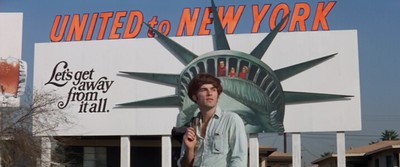
Un pilota ritorna is a heroic account of the pilot’s extraordinary if hardly credible escape:  the pilot, like Mark in Zabriskie Point, steals a plane—a British fighter Hawker Hurricane—and flies back to Italy.  The film is unusual when compared to other films in Antonioni’s canon insofar as the pilot escapes in order to return home.  Generally, Antonioni is concerned with purchasing a one-way ticket from one’s birthplace straight to nowhere, as opposed to the classic theme of the more conventional cinema:  the desire to return from Troy to Ithaca, from Oz to Kansas.  Vittoria’s flight to Verona, the other principal moment of carefree abandon that Vittoria experiences in L'eclisse, is also linked to evasion and a literal flight.  At the Hawthorne Airport in Southern California in Zabriskie Point, the camera holds on a large United Airlines billboard of the Statue of Liberty; the title of the billboard is:  “United to New York.  Let’s get away from it all.”  Indeed the flight from Los Angeles to Zabriskie Point is symmetrical with that of Rome to Verona.  For Vittoria, Verona is Zabriskie Point, both places adjoining boroughs in Arcadia.  In The Passenger, the desire to escape becomes so all consuming that it is not just a place that one wishes to leave behind, but a life.* (The Passenger was based on a story by Mark Peploe entitled “Fatal Exit.”)  The issue of “escape” in Antonioni’s films is not related to “escapism,” the desire of an audience to seek out, for example, a summer page-turning beach read or a film that is easy on the mind that permits the audience to seek refuge for several hours in a cinematic alternative world other than their own.  Antonioni’s films are for many viewers the opposite of such escapist entertainment films.  If anything, many viewers find his films so inhospitable that they wish to flee from the cinema.  It is the characters in Antonioni’s films who so often wish to escape, at Antonioni’s behest.  Viewers who yearn for escapist entertainment do not wish to see movies concerning characters who are trapped.*

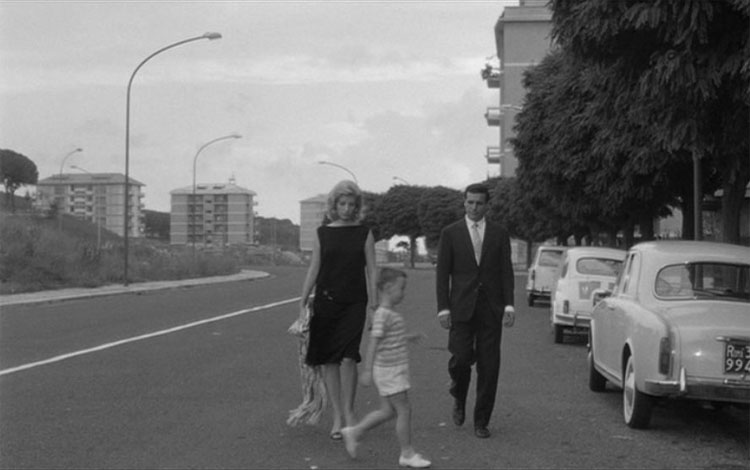
     We have already seen how Antonioni’s camera obsessively, repetitively focuses its attention on people or things for no apparent reason.  These objects of regard assume the status or role of nameless, unidentified characters.  Again, at the Verona airport, the camera follows the movements of an unidentified plane for no apparent aesthetic or other reason.  While listening in the neighborhood of the Palazzo dello Sport to the clanging poles, Vittoria finds herself standing beneath a new character, both an object and a person, a large statue atop a concrete plinth with indecipherable graffiti, of either an unidentified human being, mythological creature, or god.  (The 1964 screenplay [Sei Film] identifies the statue as that of a “woman.”  I have considered, however, whether the statue is, instead, one of Zeus, given that the Palazzo dello Sport was a venue for the 1960 Olympics and that in the religious belief system of the ancient Greeks, Zeus was the patron of the Olympics where at Olympia in antiquity was his famous statue and temple.  The possible playful association is further strengthened by the somewhat curious name of Marta’s dog, Zeus.  If you are alone, then this is a malady sent by almighty Zeus, from which there is no escape.  [Homer, The Odyssey, trans. Walter Shewring.]  Jean-François Lejeune identifies the statue as the god, Pan [see Delli Colli, Laura.  EUR é cinema, p. 50]; however, the statue does not exhibit the caprine features with characteristic hindquarters, legs, and horns resembling a faun often depicted in statuary of Pan.  I have personally never been able to locate the statue and, therefore, cannot identify it with certainty.)  Within minutes of the opening of the film, the first spectral figure to appear is that of a young boy who intrusively crosses the path of Riccardo and Vittoria as they walk in the otherwise empty streets of the Eur.  (The boy is wearing a striped shirt which chimes with the passaggio zebrato [“pedestrian black-and-white zebra stripes”] of the intersection of the contruction building that Vittoria and Piero are one day fated, like the Acheron, to cross.)
Children . . . everywhere

Children are everywhere in Antonioni’s films:  the unidentified, young boy walking towards the camera at the train station of Milazzo in L’avventura, approaching us, and kicking some object for no apparent reason; the boy is apparently not a professional actor, for like other occasional children in film, he cannot resist the temptation to break the rules and glance at the forbidden camera.  Later--again at the blasted heath of the Eur intersection--the anonymous, blond man who Vittoria remarks has a beautiful face, intersects the path of Vittoria and Piero.  There is a detached, clinical quality to Vittoria’s description of the man’s beauty; as opposed to a judgment that Piero might make, Vittoria’s observation is aesthetic, not carnal.  (There may be a kind of “protofeminism” in Antonioni’s elaboration of the shot of Vittoria stopping dead in her tracks staring for some obscure reason at the blond man; it is, after all, the more conventional Hollywood dictum that it is the woman who was made to be looked at, but forbidden to herself look.)  It is no accident that immediately following Vittoria’s admiring regard of the blond man Piero ogles the nursemaid who passes by.  In the final scene between Vittoria and Piero, Piero asks Vittoria if she remembers “the couple by the bench” that they had both seen the other day (“Senti, ti ricordi quei due l’altro giorno sulla panchina?”)  Although no verbal answer is given, a non-verbal response is offered by Vittoria as she begins to pantomime in comic fashion the expressions of this other unnamed couple.*  On several occasions, we are shown clergy coming and going, both near and far (echoing similar scenes in other films by Antonioni such as in L’avventura when a procession of seminarians dressed in their black cassocks flow like spilt, black ink before the Chiesa di S. Nicolò in the Sicilian town of Noto.  Or the striking and discrepant image seen early in Blow-Up of two black nuns in white habit seen walking on a London street).  In L'eclisse, a young priest briefly cuts right across the cinematic path of Piero on the street abutting his office building after his meeting with the Bestiola.  When Vittoria first opens the shutters in the apartment of Piero’s parents, she sees two nuns in black habit crossing the piazza, again a kind of photographic negative of the black nuns in white of Blow-Up.  At the end of Vittoria and Piero’s second meeting by the Eur water barrel, a priest passes by conspicuously in the background.  A jockey trots across the screen twice in the film, reminiscent of the mysterious camel and driver who cross David Locke’s path in the desert of The Passenger.  Towards the conclusion of L'eclisse, as Vittoria exits from the stairwell of Piero’s office building, we see in the background a mother and small daughter framed by a door, hand in hand, as they cross the street.  Is this the same mother and daughter that we had seen earlier in the Piazza di Pietra when Vittoria exits from the stock market in her first scene at the Borsa?  Or more metaphysically and less prosaically, is this Vittoria and her mother?  And at the conclusion of L'eclisse--day’s end at ground zero, or as you may like it, the mere oblivion of the seventh age of Man--there is the enigmatic old man of the coda, who we see peering out at an image that Antonioni, this time, does not show us (except in the reflected image cast in a ghostly manner on the lens of the old man’s eyeglasses), glasses that are not required to focus on the Void.  No one. Nowhere. Nothing.*

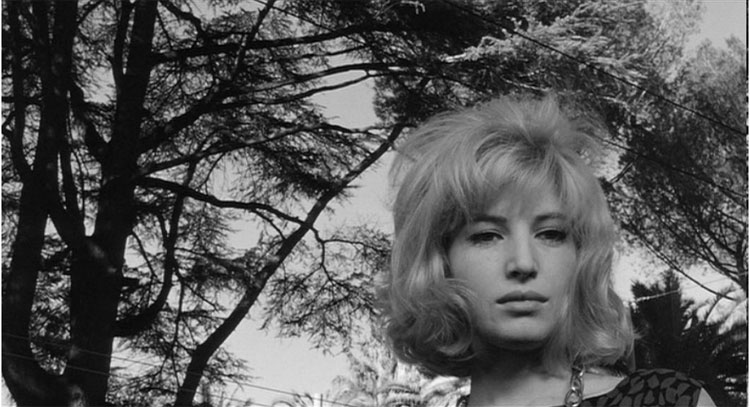
     Perhaps the most opaque and mysterious remark of L'eclisse is made by Vittoria towards the very end of the film, a remark that could excite a spasm of exegesis in a critic.  In response to a half-hearted marriage proposal by Piero, Vittoria responds that she doesn’t “miss” being married (“Io non ho nostalgia per il matrimonio.” [An odd remark reminiscent of other odd remarks in L’eclisse and in many of Antonioni’s films such as Piero’s assertion to Vittoria when they first meet in the Borsa that “Tu non mi conosci, ma io sì.” / “I know you, but you don’t know me.” Vide Endnote #22]).* Piero quite reasonably responds that “How can you miss marriage when you’ve never been married.” (“Che c’entra la nostalgia?  Non sei mica stata sposata.”).  A simple solution to this puzzling exchange might be that Vittoria regarded her relationship with Riccardo as a kind of marriage.  Another possibility is that Vittoria was married previously, but that the film offers no further exposition on this point.  (As already mentioned, we know very few of the specific biographical details of Vittoria or of the other characters in the film.)  Because Vittoria wears a ring on the fourth digit of her left hand (Piero does not), one might ask whether Vittoria is presently married to a character that is never identified (Franco?), who in some mysterious sense stands outside the film itself (raising the issue as to whether adultery--as is usually present in an Antonioni film--is characteristically present in L'eclisse). Perhaps, Vittoria simply means, “I don’t regret the fact that I’ve never married,” although this interpretation seems at odds with the meaning of “nostalgia” in Italian and also conflicts with Piero’s consternation at her remark.  Another possibility is that Antonioni is simply being coy, and is enjoying teasing his audience with incertitude, inviting wide open speculation.  My own sense is that this isn’t Antonioni’s style, tantalizing for the mere sake of tantalizing (although, Antonioni has written elsewhere in a different context that “Any explanation would be less interesting than the mystery itself.”).  The remark, however nude as it may appear, is not coming from out of nowhere.  It is finally Antonioni, and not Vittoria, who is speaking directly to us, asking us to attend.  What do we know about Vittoria based on evidence in the film itself that might explain her remark?  Groping with this question, I find myself returning to those images of Vittoria peering at trees, especially the final, haunting vision of Vittoria after she has finally left Piero, standing on the sidewalk at the spot where the Bestiola stood before her, peering up at first into a solid wall of trees.  As Scottie says to Madeleine in Vertigo of the towering trees of Big Basin Redwoods State Park near Boulder Creek, California:  “Their true name is Sequoia sempervirens—always green, ever living.”  Such trees will outlive Vittoria and Piero’s relationship which—all promises of undying love they make aside—is scheduled to end that evening at 8 pm.  Vittoria then turns around to glance up in the direction of Piero’s office above her, and then looking down towards the camera actually poised below her, Vittoria briefly gazes down from the movie screen upon we the audience below.25   Look in the mirror and wonder whether it is true that we all have a double life.  Does anybody know who anybody is?  Who is Vittoria?  How well do we really know her?  What other incarnations, which other lives has she lived?  Who then, was she married to, before?*
Goodbye . . .
Goodbye . . .

     Peculiar, riddle-like utterances occur so routinely in L'eclisse that one wonders whether a world is being portrayed in which the unusual is usual, the abnormal, normal.  I have already discussed the strange conversation between Vittoria and Piero in Vittoria’s mother’s apartment (when Vittoria seems to suggest that she--like most of us--has become smaller with age).  There is also the strange conversation in Marta’s apartment as Vittoria is analyzing the photographs of Africa that adorn the apartment walls.  Marta informs Vittoria that her Kenyan home is on the left of the photo.  Vittoria then points to an absolutely empty spot on the photo, devoid of any buildings, and asks, “Here?”  Marta then responds that the house is even more to the left as Vittoria then moves her hand to the left of the photo itself to a blank spot on the white wall.  It is some 13 years later, in the London of Blow-Up that language appears to completely break down, conversation becoming the articulation of the non sequitur.  People move their mouths and sounds issue forth, none of which seems to make sense.  In particular, the Hemmings-Photographer character of Blow-Up seems, like Vittoria, to present conflicting evidence as to whether he is married or not.  When, for example, the Hemmings character is in his studio with the mysterious Redgrave character, the phone rings.  He picks up the phone, speaks briefly, and then turns to the Redgrave character explaining, “It’s my wife.”  Seconds later, language cancels itself out when the Hemmings character states:

She isn’t my wife really.  We just have some kids . . . . No . . . . No kids.  Not even kids.  Sometimes, though it . . . it feels as if we had kids.

     By 1968, the art of conversation hasn’t gotten any more sensible across the pond in Zabriskie Point. Lee Allen, the real estate magnate played by Rod Taylor, phones the apartment of the young hippie woman, Daria, who likes to smoke grass.  A disembodied person who is never identified (Franco?) picks up the phone in Daria’s apartment and begins the conversation by saying, “Goodbye,” later ending the conversation by saying “Hello.” A Cheshire cat might as well be grinning in one of two nearby Southern California trees, suddenly speaking jabberwocky:

“I wish you wouldn’t keep appearing and vanishing so suddenly; you make one quite giddy!”

“All right,” said the Cat, and this time it vanished quite slowly, beginning with the end of the tail, and ending with the grin, which remained some time after the rest of it had gone.

“Well! I’ve often seen a cat without a grin,” thought Alice; “But a grin without a cat. It’s the most curious thing I ever saw in all my life!”

     In L'eclisse as Riccardo says his final goodbye to Vittoria, language again cancels itself out even as it is spoken:

     Riccardo to Vittoria outside her apartment at 307 Viale dell’Umanesimo:

Arrivederci . . . . Anzi, no.  Niente arrivederci, ci telefoniamo. Cioè, no. Non ci telefoniamo. (Goodbye . . . no, no good-byes, we’ll telephone each other. No, not that either.  We won’t telephone each other.)

     The dialog in many of Antonioni’s film might be described as gobbledegook, mumbo jumbo, or “walla walla” (the nonsensical speech that extras in film mumble in the background to give the appearance of true speech).  One Italian blog quotes Dino Risi as once saying: “Antonioni ha inventato l'incomunicabilità perché non sa scrivere dialoghi cinematografici.” / “Antonioni invented ‘incommunicability’ because he doesn’t know how to write dialog.” (Citation not referenced.)  http://it.answers.yahoo.com/question/index;_ylt=AoJdGPW8tQwlUmLEE8eoKrEZDgx.;_ylv=3?qid=20090228035343AA4RCXG [Retrieved 8 April 2009; site in Italian].

    In the exercise in formalism that constitutes the opening scene of L'eclisse--Vittoria’s break-up with Riccardo--there is very little language (The opening scene of Zabriskie Point depicting the students engaged in the rhetoric of revolution is, instead, nothing but talk-talk-talk.  The dialogue of the opening scenes of both films is alike, however, in that they both may be translated as adding up to nothing.) By the time we arrive at the coda to L'eclisse, language--together with the main characters of the film--is abolished entirely (Vittoria’s existence--which has been annulled--had been particularly concerned with language. She was a translator.) Insert shots such as the headlines of newspapers, “LA GARA ATOMICA,” resemble the caption cards (intertitles) of silent film, mute movies that as I have already noted were highly regarded by Hitchcock as “pure cinema.”*

     In The Passenger, Locke cannot even speak--or speak well-- the language of three of the four countries he finds himself in:  Chad, Germany, and Spain.  (Presumably, Locke has been in France as well; Antonioni in a truly grand, geographical ellipsis eliminates an entire country insofar as Locke has presumably driven from Germany to Spain by the obligatory crossing (“out”) of France.  We have also heard snippets of Locke’s poor French--Franglais/Frenglish--while he was in Chad.)  As Rifkin notes in Antonioni’s Visual Language (p. 189, note #27), “ . . . at the outset of the film [Locke] demonstrates a complete inability to communicate with the Africans who simply snapped their fingers and signaled with their hands, demanding cigarettes from the hapless Locke.”  Locke is not merely “lost in translation,” but an existential expatriate in every land and identity he finds himself inhabiting.

     Towards the end of Blow-Up when the Photographer finds himself in the pot party in Chelsea, he reencounters the model, Veruschka, whom he had earlier photographed, or--depending on one’s point of view--made love to in the beginning of the film.  The Hemmings character remarks, “I thought you were supposed to be in Paris,” to which the model replies in a solipsistic manner, “I am in Paris.”  What is peculiar is that so many of these senseless remarks seem to have some degree of sense that clings to them.  (Although Antonioni is a director who is commonly regarded as placing more emphasis on the image rather than the word, both words and images are often equally ambiguous.)  Vittoria is shrinking. Marta’s invisible Kenyan home, like the universe L'eclisse embodies, is part of a disappearing act.  Vittoria is nostalgic about things that may never have happened.  In the cannabis fog of a Chelsea night, or while smoking grass in Gower Gulch at Zabriskie Point, London is . . . Paris.*

VI.  HISTORY REPEATS ITSELF >>