Borges and the Library of Babel
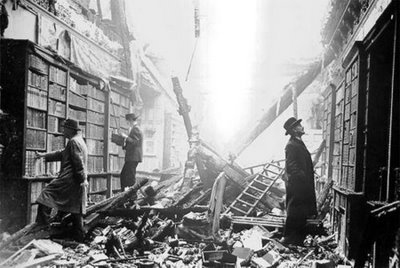
London library after the Blitz, 1940; the Eur, 1961; farenheit 451
All Blown to Kingdom Come
REFERENCES
(Note: a very comprehensive, recent bibliography of the writings by and about Antonioni and his films is contained in Vittorio Giacci's, Michelangelo Antonioni. Lo sguardo estatico. [2008]. Cited below.)
Borges and the Library of Babel
London library after the Blitz, 1940; the Eur, 1961; farenheit 451
All Blown to Kingdom Come
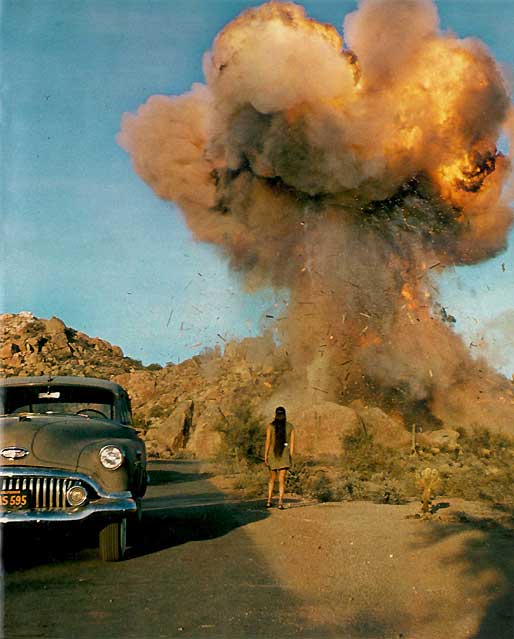
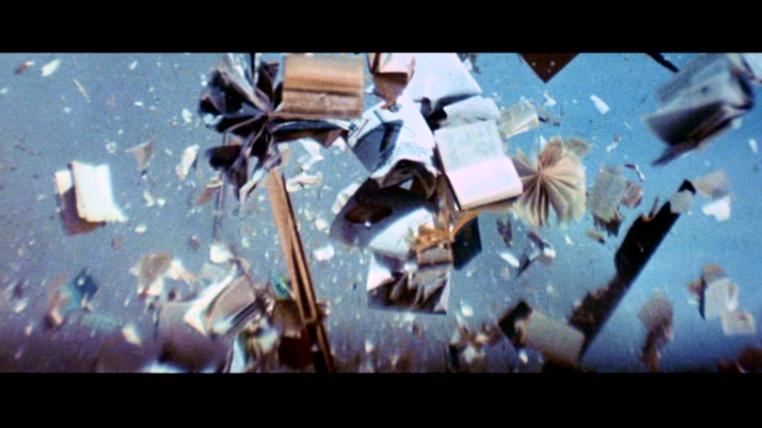
Zabriskie Point and Antonioni’s abiding apocalyptic vision
Achilli, Alberto. Boschi, Alberto. Casadio, Gianfranco. (Editors). Le sonorità del visibile. Immagini, suoni e musica nel cinema di Michelangelo Antonioni. Italy: Longo Editore Ravenna, 1999. [In Italian].
Affron, Mirella Jona. “Text and Memory in Eclipse.” Literature/Film Quarterly, Vol IX, No. 3 (1981), pp. 139-151.
Ahrens, Christian. “Michelangelo Antonionis Filme und der Manierismus.” Master’s thesis. Bundesrepublik Deutschland: Universität zu Köln, 1996. (Available on-line at: <http://www.student-online.net/Publikationen/85/> [retrieved 3 August 2009]). [In German].
Allen, Stan. Practice: Architecture, Technique and Representation (Critical Voices in Art, Theory & Culture.) London: Routledge, 2000.
Amberg, George. “But Eros is Sick.” In L’avventura, a film by Michelangelo Antonioni (Amberg, George. Editor). pp. 243-251. New York: Grove Press, 1969.
American Film Institute. The American Film Institute Catalog: Feature Films, 1961-1970, Part 2. Berkeley and Los Angeles: University of California Press, 1997.
Andrew, J. Dudley. “The stature of objects in Antonioni’s films.” TriQuarterly, 11 (1968): pp. 40-61.
Anonymous (Specific author[s] not stated). Il Davinotti. Internet site. “Le location esatte di 'L'eclisse'.” (See: <http://www.davinotti.com/index.php?option=com_content&task=view&id=377&Itemid=79> [retrieved 15 August 2013]) [In Italian].
Anonymous (Author not stated). “INTRODUZIONE STORICO ARTISTICA AL PERSONAGGIO LUIS TRENKER“ [retrieved 20 January 2011] at: <http://www.luis-trenker.it/media/Tesi_L_imperatore_della_California.pdf> [In Italian].
Antonioni, Michelangelo. “La settimana cinematografica di Venezia: L’ebreo Suss” e “Il cavaliere di Kruja.” Corriere Padano, 6 September 1940 [In Italian].
Antonioni, Michelangelo. "La sorpresa veneziana." Cinema. 25 settembre 1940-XVIII. Fascicolo 102, pp. 220-221. [In Italian].
Antonioni, Michelangelo. “Per una storia della mostra.” (Two part article). Cinema. 10 settembre 1941 and 25 settembre 1941-XIX. Fascicolo 125, pp. 151-153. Fascicolo 126, pp. 187-189. [In Italian].
Antonioni, Michelangelo. “Nuvole fotogeniche,” Cinema v.s. n°148, Anno VII, Roma, 25 agosto 1942-XX, voll. II. pp.452-453. [In Italian].
Antonioni, Michelangelo. “Questions à Antonioni.” [interview] Positif, No. 30. (July 1959). [In French, translated into English in Leprohon, Michelangelo Antonioni: An Introduction].
Antonioni, Michelangelo. “Eroticism--the Disease of Our Age.” Films and Filming (January, 1961): 7.
Antonioni, Michelangelo. “A Talk With Michelangelo Antonioni on his Work.” Transcript of an open discussion at Centro Sperimentale di Cinematografia, Rome, March 16, 1961. Excerpted in L’avventura, a film by Michelangelo Antonioni (Amberg, George. Editor). pp. 211-234. New York: Grove Press, 1969.
Antonioni, Michelangelo. Screenplays of Michelangelo Antonioni. (Brigante, Louis. Translator.) New York: The Orion Press, 1963.
Antonioni, Michelangelo. Sei film. Le amiche, Il grido, L’avventura, La notte, L'eclisse, Deserto rosso. Torino: Guilio Einaudi Editore, 1964. [In Italian].
Antonioni, Michelangelo. Blow-Up (Classic Film Scripts). London: Lorrimer Publishing Limited, 1971.
Antonioni, Michelangelo. Chung Kuo Cina. Torino: Einaudi, 1974. [In Italian].
Antonioni, Michelangelo. “La penultima inquadratura.” In PROFESSIONE: REPORTER di Michelangelo Antonioni (Di Carlo, Carlo. Editor). Un-numbered page in photography section of book between pp. 76-77. Bologna: Cappelli Editore, 1975. [In Italian].
Antonioni, Michelangelo. Quel bowling sul Tevere. Torino: Einaudi, 1983. [In Italian]. English translation published in 1986 as That Bowling Alley on the Tiber. (Arrowsmith, William. Translator.) New York-Oxford: Oxford University Press.
Antonioni, Michelangelo. Fare un film è per me vivere. (Editors: Di Carlo, Carlo and Tinazzi, Giorgio.) Venice: Marsilio, 1994. [In Italian]. English translation published in 1996 as The Architecture of Vision: Writings and interviews on Cinema. Marsilio (Not to be confused with the book Michelangelo Antonioni: Architteture della visione by Mancini and Perrella cited below).
Antonioni, Michelangelo. Cronaca di un amore. Un film di Michelangelo Antonioni. Quando un'opera prima è già un capolavoro. (Kezich, Tullio. Levantesi, Alessandra. Editors.) Torino: Associazione Philip Morris Progetto Cinema. Edizioni Lindau, 2004. [In Italian].
Antonioni, M. Pietrangeli, A. Piovene, G. Visconti, L. (Editors: Antolin, T. Barbera, A. [With: Alovisio, S.]) Il processo di Maria Tarnowska. Una sceneggiatura inedita. Italia: Museo Nazionale di Cinema. Fondazione Maria Adriana Prolo, 2006. Editrice il Castoro, 2006. [In Italian].
Aprà, Adriano. Di Carlo, Carlo. “Elements of Landscape.” Video supplement, Criterion Collection [DVD] of L'eclisse, 2005.
Archer-Straw, Petrine. Negrophilia: Avant-Garde Paris and Black Culture in the 1920s. London: Thames & Hudson, 2000. (See also on-line Internet article from “The Guardian,” 23 September 2000): <http://www.guardian.co.uk/books/2000/sep/23/features.weekend> [retrieved 25 January 2009].
Aristarco, Guido. Su Antonioni. Materiali per una analisi critica. Roma: La Zattera di Babele, 1988. [In Italian].
Arouimi, Michel. “La Rome d’Antonioni dans L’Éclipse.” Pages 167-176. In La mémoire des villes. (Clavaron, Yves and Dieterlé, Bernard. Editors.) France : Publications de l’Université de Saint-Etienne, 2003. Available on-line [retrieved 14 January 2011] at: <http://books.google.com/books?id=FYuny5TSvtEC&printsec=frontcover&dq=La+m%C3%A9moire+des+villes++By+Yves+Clavaron,+Bernard+Dieterl%C3%A9,+CELEC&hl=en&ei=rnYwTa3PNpDGsAOi5vn3BQ&sa=X&oi=book_result&ct=result&resnum=1&ved=0CCgQ6AEwAA#v=onepage&q=Arouimi&f=false> [In French].
Arrowsmith, William. Antonioni, the Poet of Images (Perry, Ted. Editor). USA: Oxford University Press, 1995.
Avagliano, Mario and Palmieri, Marco. Di pura razza italiana. L'Italia “ariana” di fronte alle leggi razziali. Milano:
Baldini&Castoldi, 2013. [In Italian].
Bachmann, Gideon. “Antonioni After China: Art Versus Science.” Film Quarterly. Vol. 28, No. 4, Special Book Issue (Summer, 1975), pp. 26-30. University of California Press.
Barroso, Miguel Ángel. M. A. Antonioni. Técnicamente dolce. Madrid: Ediciones Jaguar, 2006. [In Spanish].
Beck, Harald and Clive, Hart, with maps by Gunn, Ian. “Sunwise: The Sun in Ulysses.” Papers on Joyce 10/11 (2004-2005): 15-28.
Ben-Ghiat, Ruth. Fuller, Mia. [Editors]. Italian Colonialism. New York: Palgrave Macmillan, 2005.
Benci, Jacopo. “Michelangelo’s Rome: Towards an Iconology of L'Eclisse.” In Cinematic Rome. (Wrigley, Richard. Editor). pp. 63-84. United Kingdom: Troubador Publishing, 2008. Available on-line as of 27 September 2008 at: <http://books.google.com/books?id=5AhSkrCrAfoC&pg=PA63&dq=Jacopo+Benci&sig=ACfU3U24wll5_im7QeRgSTZGNSM-3AsiJg>
Benci, Jacopo. “Identification of a City: Antonioni and Rome, 1940-1962.” In Antonioni Centenary Essays. (Rascaroli, Laura and Rhodes, John David. Editors). pp.21-63. United Kingdom: Palgrave Macmillan on behalf of the British Film Institute, 2011.
Bennett, Joseph. “The Essences of Being.” In L’avventura, a film by Michelangelo Antonioni. (Amberg, George. Editor). pp. 276-282. New York: Grove Press, 1969.
Benvenuto, Sergio. “Freud’s Concept of Narcissism.” Journal of European Psychoanalysis. Number 1, Spring-Summer, 1995. (available on-line as of 27 September 2009 at: <http://www.psychomedia.it/jep/number1/benvenuto1.htm>)
Bernardini, Aldo. Michelangelo Antonioni. Da Gente del Po a Blow-Up. Milano: Edizioni i7, 1967. [In Italian].
Biarese, Cesare and Tassone, Aldo. I Film di Michelangelo Antonioni. Rome: Gremese, 1985. [In Italian].
Bondanella, Peter. Italian Cinema, From Neorealism to the Present. New York: Continuum, 1983.
Bondanella, Peter. The Films of Roberto Rossellini. UK: Cambridge University Press, 1993.
Bonfand, Alain. Vol. 1, Écrits: fare un film è per me vivere; Vol. 2, Cinéma de Michelangelo Antonioni. Paris : Images Modernes, 2003. [In French].
Borges, Jorge Luis. El hacedor. Buenos Aires: Emecé Editores, 1960. [In Spanish].
Brody, Richard. “Hitchcock and the Holocaust.” The New Yorker. 9 January 2014. Available on-line: http://www.newyorker.com/culture/richard-brody/hitchcock-and-the-holocaust [retrieved 24 August 2014].
Brottman, Mikita. “Risus Sardonicus: Neurotic and pyschological laughter.” Maryland Institute College of Art. Retrieved 7 April 2006 from: <http://www.degruyter.de/journals/humor/2002/pdf/15_401.pdf>
Brown, James. (Untitled Internet article; copyright May, 2002.) Retrieved from: <http://www.sensesofcinema.com/contents/directors/02/antonioni.html>
Brunette, Peter. The Films of Michelangelo Antonioni. UK: Cambridge University Press, 1998.
Brunette, Peter. Roberto Rossellini. University of California Press, 1996.
Buckley, Martin. Cars in Films: Great Moments in Post-War International Cinema. Haynes Publications Inc., 2001.
Buñuel, Luis. Mon dernier soupir. (Autobiography, “My Last Sigh”). Co-written with Jean-Claude Carrièr. Originally published in French. Paris: © Editions Robert Laffont, 1982. Subsequently translated into multiple languages.
Calabretto, Roberto. Antonioni e la musica. Italia: Marsilio Editori, 2012. [In Italian].
Capozzi, Rocco. “Eco’s Prophetic Vision of Mass Culture.” In McLuhan Studies. Premiere Issue. Retrieved 4 October 2005 from: <http://www.chass.utoronto.ca/mcluhan-studies/v1_iss1/1_1art10.htm>
Cardullo, Bert. Conversations with Stanley Kauffmann. University Press of Mississippi, 2003.
Cardullo, Bert. (Editor). Michelangelo Antonioni: Interviews. University Press of Mississippi, 2008. Retrieved 3 April 2009 on-line in an edited “preview” at: <http://books.google.com/books?id=5PIfqF7BP9wC&printsec=frontcover#PPP1,M1>
Catterall, Ali and Wells, Simon. Your Face Here. British Cult Movies Since the Sixties. UK: Fourth Estate, 2001.
Cavallaro, G. B. “M. Antonioni simbolo di una generazione.” Bianco e Nero. sett. 1957. (Cited by Biarrese and Tassoni). [In Italian].
Chatman, Seymour. Antonioni, or, The Surface of the World: University of California Press, 1985.
Chatman, Seymour. Duncan, Paul. (Editors). Michelangelo Antonioni, The Investigation [“The Complete Films”]. Köln, Bundesrepublik Deutschland: Taschen, 2004.
Chatman, Seymour. Fink, Guido. (Editors). L’avventura, Michelangelo Antonioni, Director. New Brunswick and London: Rutgers University Press, 1989.
Chiaretti, T. “Osservazioni sullo stile.” In L'eclisse di Michelangelo Antonioni. (Lane, John Francis. Editor). Capelli editore, 1962. [In Italian].
Chiaretti, T. “The Adventure of L’avventura.” Excerpted in L’avventura. (George Amberg, editor). pp. 185-208. New York: Grove Press, 1969.
Cinesicilia, Giunti Progetti Educativi (multiple editors). Sicilia. Guida ai luoghi del cinema. Palermo: Cinesicilia, 2009. [In Italian].
Corner, Paul. Fascism in Ferrara, 1912-1925. London: Oxford University Press, 1975.
Cowie, Peter. Antonioni, Bergman, Renais. London: The Tantivy Press, 1963.
Cuevas, Bryan J. Travels in the Netherworld: Buddhist Popular Narratives of Death and the Afterlife in Tibet. New York, New York (USA): Oxford University Press, 2008.
Cunningham, Douglas A. (Editor). The San Francisco of Alfred Hitchcock's Vertigo : Place, Pilgrimage, and Commemoration. Maryland: Rowman & Littlefield, 2012.
David, Michel. “Introduzione.” In La noia. Moravia, Alberto. IX edizione “I Grandi Tascabili.” Milano: Bompiani, 1999. [In Italian].
Delli Colli, Laura (Editor). Eur, si gira. Tra cinema, architettura, fiction e pubblicità la storia e l’immagine di un set unico al mondo. Italia: Lupetti, 2005. [In Italian].
Delli Colli, Laura. EUR é cinema. Italia: Palombi Editori, 2008. [In Italian].
Delli Colli, Laura and Lancia, Enrico. Monica Vitti. Italia: Gremese Editore, 1987. [In Italian].
Dewey, Donald. Marcello Mastroianni: His Life and Art. Carol Publishing Group, 1993.
Di Biagi, Flaminio. Il cinema a Roma. Guida alla storia e ai luoghi del cinema nella capitale. Roma: Palombi Editori, 2003. [In Italian].Di Carlo, Carlo (Editor). Michelangelo Antonioni. Rome: Edizioni di Bianco e Nero, 1964. [In Italian].
Di Carlo, Carlo (Editor). Il primo Antonioni. Bologna: Cappelli editore, 1973. [In Italian].
Di Carlo, Carlo (Editor). Professione: reporter di Michelangelo Antonioni (screenplay). Bologna: Cappelli editore, 1975. [In Italian].
Di Carlo, Carlo and Tinazzi, Giorgio. (Editors). Michelangelo Antonioni. Sul cinema. Venezia (Italy): Marsilio Editori, 2004. [In Italian].
Düttmann, Alexander García. “QUASI: Antonioni and Participation in Art.” Antonioni Centenerary Essays. [pp. 154-166]. United Kingdom: Palgrave Macmillan on behalf of the British Film Institute, 2011.Ebner, Michael. Ordinary Violence in Mussolini’s Italy. Cambridge University Press, 2010.
Eliot, Marc. Nicholson: a Biography. P. 124. New York: Crown Archetype, 2013.
Esposito, Joan. “Antonioni and Benjamin: Dialectical Imagery in Eclipse.” Film Criticism, VOL. IX, NO. 1 (Fall 1984): pp. 25-37.
Farina, M. Debora. ‘Eros is Sick,’ Il Cinema Di Michelangelo Antonioni. Cannes: Editrice Cinetecnica, 2005. [In Italian].
Ferrero, Adelio (Editor). Tradizione e innovazione nel cinema degli autori Emiliano-Romagnoli. Comune di Modena, 1976. [In Italian].
Fink, Guido. “Michelangelo Antonioni, A Biographical Sketch.” In L’avventura, Michelangelo Antonioni, director. pp. 17-28 (Chatman, Seymour and Fink, Guido. Editors). New Brunswick and London: Rutgers University Press, 1989.
Folli, Anna. Vent'anni di cultura ferrarese: 1925-1945. Antologia del “Corriere Padano.” Volume primo. Bologna (Italy): Pàtron Editore, 1978. [In Italian].
Font, Domènec. Michelangelo Antonioni. Madrid: Ediciones Cátedra, 2003. [In Spanish].
Forgacs, David. “FACE, BODY, VOICE, MOVEMENT: Antonioni and Actors.” In Rascaroli, Laura and Rhodes, John David. (Editors). Antonioni Centenary Essays. [pp. 167-182]. United Kingdom: Palgrave Macmillan on behalf of the British Film Institute, 2011.
Freccero, John. “BLOW-UP: From the Word to the Image.” In Focus on Blow-Up. Englewood Cliffs, New Jersey: Prentice Hall, Inc., 1971.
Friedländer, Saul. Nazi Germany and the Jews, 1933-1945. Malestrom, 2009. Available on-line at: http://www.scribd.com/doc/28107437/Nazi-Germany-and-the-Jews-1933-1945-Abridged-Edition-2009-Malestrom (retrieved 30 May 2010).
Garner, Philippe and Mellor, David Allan. Antonioni’s Blow-Up. Göttingen, Bundesrepublik Deutschland: Steidl, 2010.
Gay, Peter. Freud. A Life for our Time. New York, London: W. W. Norton & Company, 1988.
Genovese, Nino (Editor). Omaggio a Michelangelo Antonioni. Messina nella sua Avventura. Comune di Messina (Italia): DAF - Associazione Culturale, 2007. [In Italian].
Giacci, Vittorio. Michelangelo Antonioni. Lo sguardo estatico. Italy: Fondazione Centro Sperimentale di Cinematografia, 2008. [In Italian].
Giametti, David. Invito al Cinema di Antonioni. Milano: Gruppo Ugo Mursia Editore, 1999. [In Italian].
Gilman, Richard. “About Nothing--with Precision.” Theater Arts 46, no. 7 (July, 1962): pp. 10-12.
Girón Echevarría, Luis. “The Automobile as a Central Symbol in F. Scott Fitzgerald.” Revista Alicantina de Estudios Ingleses 6 (1993): 73-78. [Spain]. Available as of 12 March 2009
on-line at: http://rua.ua.es/dspace/bitstream/10045/6171/1/RAEI_06_06.pdf
Goldhagen, Daniel Jonah. Hitler's Willing Executioners: Ordinary Germans and the Holocaust. USA: Vintage, 1997.
Gundle, Stephen. “Miss Italia in Black and White: Feminine Beauty and Ethnic Identity in Modern Italy.” In Migrant Cartographies: New Cultural and Literary Spaces in Post-Colonial Europe. Pages 253-266. (Ponzanesi, Sandra and Merolla, Daniela. Editors.) Lanham, MD, USA: Lexington Books, 2005.
Harris, Robert A. and Lasky, Michael S. The Complete Films of Alfred Hitchcock. New York: Citadel Press Film Series, 2002.Helmore, Edward. “Hollywood and Hitler: Did the studio bosses bow to Nazi wishes?” The Guardian. The Observer, 29 June 2013. Accessible on-line as of 4 August 2013 at: http://www.theguardian.com/film/2013/jun/29/historian-says-hollywood-collaborated-with-nazis
Hemmings, David. Blow-Up and other Exaggerations. UK: Chrysalis Books Group, 2004.
Huss, Roy (Editor). Focus on Blow-Up. Englewood Cliffs, New Jersey: Prentice-Hall, Inc., 1971.
Internet Movie Cars Database (IMCDB), <http://www.imcdb.org/>, retrieved 25 October 2007
Jacobs, Steven. “Between E.U.R. and L.A.: Townscapes in the Work of Michelangelo Antonioni.” In The Urban Condition: Space, Community, and Self in the Contemporary Metropolis. pp. 324-242. (Edited by GUST [Ghent Urban Studies Team]). 010 Publishers, 1999. Accessible on-line as of 26 September 2008 at: <http://books.google.com/books?id=-vbTkMuU9NkC&pg=PP1&dq=Dirk+de+Meyer,+Kristiaan#PPA325,M1>
Joseph, Robert. “Billboards, Beards and Beads.” Cinema Vol. 4, No. 4 (December, 1968): pp. 2-6.
Joyce, James. Ulysses. The corrected text. (Gabler, Hans Walter. Editor). New York: Random House, 1986.
Kaiser, Tina Hedwig. Flaneure im Film. La Notte und L’Eclisse von Michelangelo Antonioni. Marburg ( Bundesrepublik Deutschland): Tectum Verlag, 2007. [In German].
Kawin, Bruce F. Mindscreen, Bergman, Godard, and First-Person Film. Princeton: Princeton University Press, 1978.
Kawin, Bruce F. How Movies Work. Berkeley and Los Angeles: University of California Press, 1992.
Kearns, J.W. “Antonioni’s ‘Blow Up.’ ” Article on Internet Blog: Accessible on-line as of 16 February 2010 at: <http://www.idyllopuspress.com/meanwhile/924/antonionis-blow-up-the-bread-and-the-wine-the-body-and-the-blood/>
Kermode, Frank. The Sense of an Ending. Studies in the Theory of Fiction. New York: Oxford University Press, 1967.
Labarthe, André. “Entretien avec Michelangelo Antonioni.” Cahiers du cinéma, no 112 (October 1960). pp. 1-14. (excerpted in Leprohon, Michelangelo Antonioni: An Introduction).
Lai, Sandro (Director). Michelangelo Antonioni: The Eye That Changed Cinema. 56-minute documentary originally aired on Italian television (2001) with the title, Michelangelo Antonioni: Lo sguardo che ha cambiato il cinema. Supplement contained on Disc Two of The Criterion Collection DVD (2005) of L’eclisse.
Lancia, Enrico. Poppi, Roberto. (Editors). Dizionario del cinema italiano. Gli attori. Vol. 3, Part 1. Italia: Gremese Editore, 2003. [In Italian]. Available on-line as of 29 September 2008 at: <http://books.google.com/books?id=WDKOut-MkCwC&printsec=frontcover&dq=l%27eclisse+bandiera&lr=&sig=ACfU3U3POfLhwdLucZvMHSCpTPQtywwp0A&source=gbs_book_other_versions_r&cad=1_2#PPA28,M1> [In Italian]
Landy, Marcia. Italian Film. Cambridge, United Kingdom: Cambridge University Press, 2000.
Lane, John Francis. “Antonioni Diary: A Day-to-Day Record of Work on The Eclipse.” Films and Filming 8, No. 6 (March 1962): pp. 11-12, 46.
Lane, John Francis (Editor). L'eclisse di Michelangelo Antonioni. Italia: Cappelli editore, 1962. [In Italian].
Lane, John Francis. To Each His Own Dolce Vita. Cambridge, United Kingdom: Bear Claw Books, 2013.
Lejeune, Jean-François. “La metafisica del quotidiano. L’Eur di Antonioni e L’eclisse dell’architettura.” In EUR é cinema (Delli Colli, Laura). Italia: Palombi Editori, 2008. [In Italian].
Leprohon, Pierre. Michelangelo Antonioni: An Introduction. [translated from the original French]. New York: Simon and Schuster, 1963.
Lewis, Norman. Naples '44. A World War II Diary of Occupied Italy. New York, NY: Carroll & Graf edition, 2005 (Copyright 1975 by Norman Lewis).
Lindgren, Ernest. The Art of the Film. London: Allen & Unwin, 1948.
Love, Matthew. “Michelangelo Antonioni. The Early Years, 1935-1950.” Available on-line at: http://www.academia.edu/4600721/Michelangelo_Antonioni_The_early_years_1935-1950 [retrieved 29 May 2014]. Date of Publication: 19 June, 2008.
Lyons, Robert Joseph. Michelangelo Antonioni’s neorealism: A World View. New York: Arno Press, 1976.
MacDonald, Dwight. Dwight MacDonald on Movies. p. 38. Englewood Cliffs, N.J.: Prentice-Hall, 1969.
MacDonald, Dwight. “The Grandeur and Misery of Antonioni.” Excerpted in L’avventura, a film by Michelangelo Antonioni. (Amberg, George. Editor). pp. 273-275. New York: Grove Press, 1969.
Malamud, Randy. The Language of Modernism. Ann Arbor: UMI, 1989. (Cited by Norton, Glen. W.).
Manceaux, Michèle. Interview with Antonioni, reprinted in Sight and Sound, Winter 1960-1961. (Cited by Cowie, Ibid.)
Mancini, Michele and Perrella, Giuseppe. Michelangelo Antonioni. Architetture della visione. Rome: Coneditor Consorzio Coop, 1986. [In Italian and English; I have also seen an edition in Italian and Spanish].
Marcus, Millicent Joy. Italian Film in the Light of Neorealism. Princeton, New Jersey: Princeton University Press, 1986.
Marcus, Millicent Joy. Italian Film in the Shadow of Auschwitz. Toronto: University of Toronto Press, 2007.
Martini, Giocomo (Editor). Una Regione piena di cinema. Michelangelo Antonioni. Regione Emilia-Romagna, edizioni falsopiano. (Date of publication not indicated; ISBN 88--89782-12-9). [In Italian with accompanying partial English translation].
Mast, Gerald. A Short History of the Movies. New York: Pegasus, 1971. p. 353 [Cited by Lyons].
Mattanza, Alessandra. CINEMA / INTERVISTA / Dietro una finestra, una storia. 9 April 2006. Retrieved 8 January 2007 from <http://www.oggi7.info/dettaglio.asp?Art_Id=2434&Art_Tema=Interviste>
Medved, Harry with Dreyfuss, Randy. The 50 Worst Films of All Time. New York: Warner Books, Inc., 1984.
Micha, R. “L’eau dans l’œuvre d’Antonioni,” Critique, April 1965. [In French].
Miccichè, Lino. Antonioni visto da Antonioni (“Antonioni Seen by Antonioni”). [Interview, 28']. Italy: RAI television, 1978.
Minghelli, Giuliana. Landscape and Memory in Post-Fascist Italian Film: Cinema Year Zero. New York, NY: Routledge, 2013.
Mingozzi, Gianfranco (Director). Antonioni: documents et temoinage. 58-minute documentary originally aired on Italian television (1966) with the title, Michelangelo Antonioni storia di un autore. Supplement contained on Disc Two of The Criterion Collection DVD (2001) of L’avventura [In French and Italian with English sub-titles].Monaco, James. How to Read a Film. The Art, Technology, Language, History, and Theory of Film and Media. Oxford University Press, 1981.
Moravia, Alberto. “Il terrore di Roma.” In Racconti romani. Milano: Bompiani, 1992. [In Italian; widely translated into multiple languages].
Moses, Gavriel. Eclipse, The Opening Sequence. (Monograph, 46 pages). Mount Vernon, N.Y.: Macmillan Films, Inc., 1975.
Moure, José. Michelangelo Antonioni, Cinéaste de l’Évidement. Paris : L`Harmattan, 2001. [In French].
Müller, Uwe. Der intime Realismus des Michelangelo Antonioni. Bundesrepublik Deutschland: Herstellung und Verlag, 2004. [In German].
Nicholl, Charles. The Lodger Shakespeare: His Life on Silver Street. New York: Viking Adult, 2008.Norton, Glen W. “Antonioni’s Modernist Language.” Internet site, retrieved 21 April 2006 from:
<http//:www.geocities.com/hollywood/3781/modernism.html?200621>
Nowell-Smith, Geoffrey. “Shape around a Black Point.” In L’avventura, Michelangelo Antonioni, director. pp. 198-200. (Chatman, Seymour and Fink, Guido, Editors). Rutgers University Press, 1989.
Nowell-Smith, Geoffrey. L’avventura. London: British Film Institute, 1997.
Nurden, Robert. “On the Trail of the Swinging Sixties.” The Independent. 21 September 2011. Available on-line at: http://www.independent.co.uk/travel/uk/on-the-trail-of-the-swinging-sixties-415444.html
Ockman, Joan. “Architecture in a Mode of Distraction: Eight Takes on Jacques Tati’s Playtime.” p. 183. In Architecture and Film (Lamster, Mark. Editor). New York: Princeton Architectural Press, 2000.
Orr, John. Cinema and Modernity. Cambridge, UK: Polity press, 1993.
Pansa, Giampaolo. Bella ciao. Controstoria della Resistenza. Italia: Rizzoli, 2014. [In Italian].
Payne, Stanley G. A History of Fascism, 1914-1945. UK: Routledge, 1995.
Pechter, William S. “On L’avventura.” Excerpted in L’avventura, a film by Michelangelo Antonioni. (Ambrose, George. Editor.) Pages 283-287. New York: Grove Press, 1969.
Pechter, William S. “Antonioni ‘75.” Commentary 60 (August, 1975): 72.
Peña, Richard. Audio Commentary, L'eclisse. DVD. The Criterion Collection, 2005.
Peploe, Mark. Wollen, Peter. Antonioni, Michelangelo. Michelangelo Antonioni’s “The Passenger.” New York: Grove Press, Inc., 1975.
Perez, Gilberto. “The Point of View of a Stranger.” In The Material Ghost, Films and their Medium. pp. 367-416. The Johns Hopkins University Press, 1998.
Perry, Ted. “A contextual Study of M. Antonioni’s Film L'eclisse.” Speech Monograph, 37, No. 2 (June, 1970), 79-100.
Perry, Ted and Prieto, René. Michelangelo Antonioni: A Guide to References and Resources. Boston: G. K. Hall, 1986.
Petti, Edoardo Maria. Ricciarelli, Lorenzo. Scarpetti, Roberto. Rome, the Great Movie Set. Pages 38-41. Published in both English and Italian editions (undated) by the Azienda di Promozione Turistica di Roma. Available on-line as of 3 October 2008 at: <http://www.italiantouristoffice.dk/dk/docs/1196.pdf>
Pincus, Karen. “Empty Spaces. Decolonization in Italy.” In A Place in the Sun: Africa in Italian Colonial Culture from Post-unification to the Present. Pages 299-321. (Palumbo, Patrizia. Editor.) Berkeley and Los Angeles: University of California Press, 2003.
Pomerance, Murray. “The Passenger.” In Michelangelo Red Antonioni Blue, Eight Reflections on Cinema. Pages 199-234. Berkeley and Los Angeles: University of California Press, 2011.
Prédal, René. Michelangelo Antonioni ou la vigilance du désir. Paris : Les Éditions du Cerf., 1991. [In French].
Prédal, René. “L’Éclipse, l’ellipse.” In L’Avant-Scène Cinéma. (Entire issue devoted to L'eclisse). February/février, 1993. nº 419. [In French and Italian].
Prince, Stephen. The warrier’s camera: the cinema of Akira Kurosawa. Princeton University Press, 1999.
Quaresima, Leonardo. “ ‘MAKING LOVE ON THE SHORES OF THE RIVER PO’: Antonioni’s Documentaries.” In Rascaroli, Laura and Rhodes, John David. (Editors). Antonioni Centenary Essays. [pp. 115-133]. United Kingdom: Palgrave Macmillan on behalf of the British Film Institute, 2011.
Rascaroli, Laura and Rhodes, John David. (Editors). Antonioni Centenary Essays. United Kingdom: Palgrave Macmillan on behalf of the British Film Institute, 2011.
Reeves, Tony. The Worldwide Guide to Movie Locations. London: Titan Books, 2006.
[See Internet version retrieved 15 October 2007 at <http://www.movie-locations.com>].
Reich, Jacqueline. Beyond the Latin Lover : Marcello Mastroianni, Masculinity, and Italian Cinema. Bloomington: University of Indiana Press, 2004.
Reggiani, Stefano. “L’altro occhio della realtà.” In Professione: Reporter di Michelangelo Antonioni (screenplay). Di Carlo, Carlo (Editor). Bologna (Italy): Cappelli Editore, 1975. [In Italian].
Rentschler, Eric. The Ministry of Illusion: Nazi Cinema and its Afterlife. Cambridge (USA): Harvard University Press, 1996.
Renzi, Renzo. “Album Antonioni. Une biographie impossible.” Volume 3 of L’oeuvre de Michelangelo Antonioni. (Di Carlo, Carlo. Editor). Roma: Cinecittà International, 1990. [In French].
Restivo, Angelo. The cinema of economic miracles : visuality and modernization in the Italian art film. Durham, North Carolina: Duke University Press, 2002.
Restivo, Angelo. “Revisiting Zabriskie Point.” In Antonioni Centenary Essays. Rascaroli, Laura and Rhodes, John David. (Editors). [pp. 82-97]. United Kingdom: Palgrave Macmillan on behalf of the British Film Institute, 2011.
Rhodes, John David. “The Eclipse of Place: Rome’s EUR from Rossellini to Antonioni.” In Taking Place. Location and the Moving Image. Rhodes, John David and Gorfinkel, Elena. (Editors). [pp. 31-55]. Minneapolis: University of Minnesota Press, 2011. (Available on-line at: <http://books.google.de/books?id=EgX7xFIGHiYC&pg=PA31&dq=Place:Rome%27s&hl=de&sa=X&ei=7JIVUdWXIOj3igLpioGADA&ved=0CEAQ6AEwAQ#v=onepage&q=Place%3ARome%27s&f=false> [Retrieved 8 February 2013]
Ribstein, Larry E. “Wall Street and Vine: Hollywood’s View of Business,” Illinois Law & Economics Working Paper LE05-010. (Available on-line at: <http://law.bepress.com/cgi/viewcontent.cgi?article=1496&context=alea> [Retrieved 28 May 2012]
Richie, Donald. The Films of Akira Kurosawa. University of California Press, 1996.
Rifkin, Ned. Antonioni’s Visual Language. Ann Arbor, Michigan: UMI Research Press, 1982.
Rohdie, Sam. Antonioni. London: British Film Institute, 1990.
Rosenbaum, Jonathan. “A Vigilance of Desire: Antonioni’s L'eclisse.” In Michelangelo Antonioni’s L'eclisse. pp. 7-11. Booklet contained in The Criterion Collection DVD, L'eclisse. 2005.
Rudman, Mark. Realm of Unknowing: Meditations on Art, Suicide, and Other Transformations. Hanover, New Hampshire: Weslayan University Press published by University Press of New England, 1995.
Rushing, Robert A. Resisting Arrest: Detective Fiction and Popular Culture. New York: Other Press, 2007.
Russell, Catherine. The Cinema of Naruse Mikio : Women and Japanese Modernity. Durham and London: Duke University Press, 2008.
Russell, Lawrence. “The Passenger.” (Internet article.) http://www.culturecourt.com/F/Antonioni/ThePassenger.htm (“Culture Court.” 2006 [accessed 11 May 2010].
Salinger, J. D. “For Esmé – with Love and Squalor.” In Nine Stories. New York: Little, Brown edition: 1953.
Samuels, Charles Thomas. Encountering Directors. New York: G.P. Putnam’s Sons, 1972.
Schickel, Richard. Perry, George. You Must Remember This: The Warner Bros. Story. Philadelphia: Running Press, 2008.
Schindler, Stephen K. Koepnick, Lutz P. (Editors). The Cosmopolitan Screen : German Cinema and the Global Imaginary, 1945 to the Present. University of Michigan Press, 2007.
Schwarzer, Mitchell. “The Consuming Landscape: Architecture in the Films of Michelangelo Antonioni.” pp. 196-215. In Architecture and Film (Lamster, Mark. Editor). New York: Princeton Architectural Press, 2000.
Shapiro, Jerome F. “Atomic Bomb Cinema: Illness, Suffering, and the Apocalyptic Narrative.” Literature and Medicine. 17(1): pp. 126-148. 1998.
Shapiro, Jerome F. Atomic Bomb Cinema. New York: Routledge, 2002.
Simon, John. “Thoughts on L’avventura.” Excerpted in L’avventura, a film by Michelangelo Antonioni. (Amberg, George. Editor.) pp. 267-272. New York: Grove Press, 1969.
Simon J, Gelmis J, Last M, Star H, Lees A. “Antonioni: What’s the Point?” Film Heritage. vol. 5 no., 3, Spring 1970. [cited by Rohdie].
Sinclair, Andrew. “Blow-Up: A Memoir.” In Blow-Up, a film by Michelangelo Antonioni (Sinclair, Andrew. Editor.) pp. 18-21. London: Lorrimer Publishing Limited, 1971.
Sitney, P. Adams. Vital Crises in Italian Cinema. Iconography, Stylistics, Politics. Austin: University of Texas Press, 1995.
Socor, Barbara J. “Imagining Desire and Imagining the Real: A Love Story.” In Celluloid Couches, Cinematic Clients. Psychoanalysis and Psychotherapy in the Movies (Brandell, Jerrold R. Editor.) pp. 191-216. Albany: State University of New York Press, 2004.
Sontag, Susan. Against Interpretation. New York, NY: Farrar, Straus and Giroux, 1966.
Staggs, Sam. Close-Up on Sunset Boulevard: Billy Wilder, Norma Desmond, and the dark Hollywood dream. New York: St. Martin’s Press, 2002.
Stanton, Edward. “Antonioni’s The Passenger: A Parabola of Light,” Literature/Film Quarterly 5 (Winter 1977): p. 63. (Cited by Chatman in Antonioni, or, The Surface of the World, p. 263, note # 41).
Stegner, Wallace and Mary. “Introduction.” In Great American Short Stories p. 22. New York: Dell Publishing Co., Inc., 1957.
Stewart, Garrett. Framed Time. Chicago and London: University of Chicago Press, 2007.
Stone, Marla. “The Last Film Festival: The Venice Biennial Goes to War.” In Re-viewing Fascism: Italian Cinema, 1922-1943. (Reich, Jacqueline and Garofalo, Piero. Editors.) Pages 293-314. Bloomington and Indianapolis: Indiana University Press, 2002.
Stratton, Jon. “Man-Made Women.” Australian Humanities Journal. Retrieved October 18, 2006 from
<http://www.lib.latrobe.edu.au/AHR/archive/Issue-Sept-1996/stratton.html>
Strick, Philip. “Antonioni, ‘A Motion Monograph’.” Motion No. 5 (March, 1963), p. 23 (Cited by Gavriel Moses).
Tailleur, Roger and Thirard, Paul-Louis. Antonioni. Paris : Editions Universitaires, 1963. [In French].
Taubman, William. Khrushchev. The Man and His Era. New York: W.W. Norton & Company Inc., 2003.Thomson, Ian. Primo Levi : a life. New York: Metropolitan Books, 2003.
Thornton, Weldon. Allusions in Ulysses. The University of North Carolina Press, 1961.
Tiegel, Susan. Jew Süss: Life, Legend, Fiction, Film. London and New York: Continuum International Publishing Group, 2011.
Tinazzi, Giorgio. Michelangelo Antonioni. Milano: Il Castoro Cinema, 1994. [In Italian].
Torriglia, Anna Maria. Broken Time, Fragmented Space: A Cultural Map for Postwar Italy. University of Toronto Press, 2002.
Trosman, Harry. Contemporary Psychoanalysis and Masterworks of Art and Film. New York and London: New York University Press, 1999.
Turner, Jack. “Antonioni’s The Passenger as Lacanian Text.” Other Voices, The (e) Journal of Cultural Criticism. v.1, n.3 (January 1999). <http://www.othervoices.org/1.3/jturner/passenger.html> [retrieved 26 March 2008].
Vanoye, Francis. Profession : reporter. Michelangelo Antonioni. Nathan, 1992. [In French].
Violet, Bernard. Les mystères Delon. France: Flammarion, 2000. [In French].
Vitella, Federico. Michelangelo Antonioni. L'avventura. Torino (Italia): Lindau s.r.l., 2010. [In Italian].
Walker, Beverly. “Michelangelo and the Leviathan. The Making of Zabriskie Point.” Film Comment, September-October 1992, pp. 36-49.
Wenders, Wim. My Time With Antonioni. London: Faber and Faber, 2000.
Wood, Robin. Hitchcock's Films Revisited. New York: Columbia University Press, 1989.
Zeilmann, Achim. Drehort München: Wo berümpte Filme entstanden. Berlin-Brandenburg: edition q in der Be.Br verlag GmbH, 2008. [In German].
Zolla, Elémire. L'eclisse dell’intellettuale. Milano (Italia): Bompiani, 1959. [In Italian].
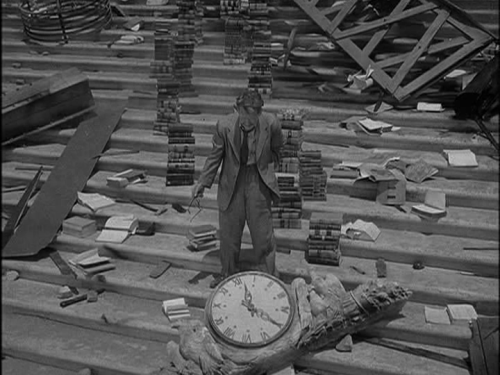
Time Enough at Last